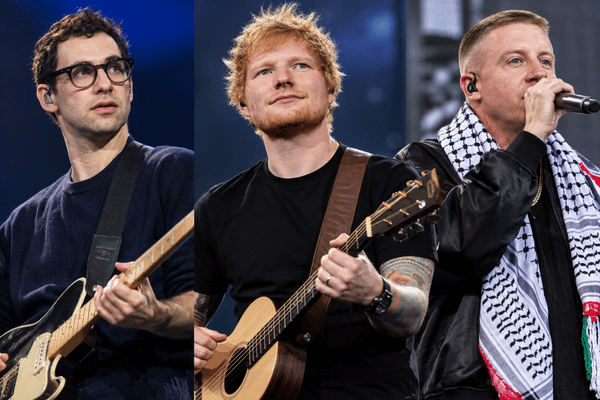
Jack Antonoff is taking a strong stand against the decision to remove Macklemore from Ed Sheeran’s Loop Tour, arguing that the British superstar had an opportunity to challenge the influence of powerful stadium owners rather than comply with their demands.
In an interview with The Guardian published October 25, the Grammy-winning producer and Bleachers frontman criticized Sheeran’s handling of the controversy, suggesting that canceling the entire tour would have sent a far more meaningful message.
Antonoff proposed an alternative in which Sheeran could have performed free concerts outside the scheduled venues while raising money for charitable causes. He believes such a move would have demonstrated that artists are not obligated to surrender their principles to wealthy individuals who control major concert facilities.
The dispute began in September when Macklemore was removed from the North American portion of Sheeran’s Loop Tour following performances at MetLife Stadium in New Jersey.
During those appearances, the Seattle rapper expressed support for Palestinians, addressed the humanitarian crisis in Gaza and the occupied West Bank, and performed his politically charged song “Hind’s Hall.” His performances also featured images depicting destruction from the war in Gaza.
The controversy intensified when Macklemore identified New England Patriots owner Robert Kraft as a central figure in his removal from the tour.
According to Macklemore, Kraft prohibited him from performing at Gillette Stadium and encouraged other stadium owners to pressure Sheeran into removing him from the lineup.
Kraft subsequently acknowledged barring Macklemore from Gillette Stadium but did not publicly respond to the allegation that he had coordinated efforts with other venue owners.
The decision triggered significant criticism within the music community and prompted several artists to withdraw from Sheeran’s touring schedule.
Among those who departed were Finneas, who had been scheduled to support the South American leg, and Lukas Graham. Irish folk group Beoga, which had been joining Sheeran onstage for a portion of his concerts, also exited the tour.
For Antonoff, the situation represents something larger than a disagreement over one performer or one concert series.
The producer, known for his work with Taylor Swift and other major recording artists, believes the dispute highlights the power that wealthy business figures can exercise over musicians and their ability to express political opinions.
Antonoff also addressed his own experiences speaking about Palestinian rights. Although he has encountered criticism for expressing solidarity with Palestinians, he said the controversy surrounding Macklemore has strengthened his determination to continue doing so.
He rejected the idea that calling for Palestinian freedom should automatically be considered controversial, framing his position as a matter of basic human concern.
Antonoff further indicated that he would be willing to perform outside traditional concert venues rather than allow promoters or stadium executives to dictate his public statements.
His comments add another prominent voice to a dispute that has extended beyond Sheeran’s tour and into a broader conversation about the relationship between artistic independence, political activism, and corporate influence.
With several musicians already distancing themselves from the tour, the controversy has become a high-profile example of the tensions artists can face when their public positions collide with the interests of major entertainment venues.
For Antonoff, the central question is whether musicians with substantial audiences and financial resources are willing to challenge those interests when their principles are at stake.
