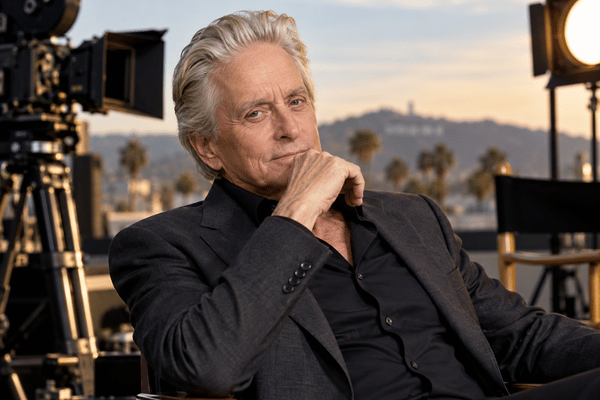
Michael Douglas has spent decades playing men whose confidence often conceals something far messier underneath. Now, the Oscar-winning actor and producer is turning the camera back on himself.
In his memoir One Helluva Ride, Douglas revisits a life shaped by Hollywood fame, family expectations, career-defining movies and personal turmoil. Rather than simply moving through his story chronologically, he uses a dozen films to explore moments when his work and private life began reflecting one another.
Long before Douglas became a major star in his own right, he was Kirk Douglas’ son.
Growing up with one of Hollywood’s most commanding leading men as a father created an unusual benchmark. Kirk Douglas had built an image around toughness, determination and an almost larger-than-life physical presence. For Michael, establishing his own identity meant finding a way to succeed without simply trying to become another version of his father.
He eventually did exactly that.
Douglas won his first Academy Award as a producer of One Flew Over the Cuckoo’s Nest, the celebrated film his father had previously worked to bring to the screen. Years later, Michael Douglas stepped fully into the spotlight as an actor with Wall Street, winning an Oscar for his portrayal of Gordon Gekko.
That performance also helped cement a fascinating pattern in his career. Douglas repeatedly found himself playing successful men whose ambitions, appetites and decisions threatened to consume them.
Few movies demonstrated that better than Fatal Attraction.
Douglas has described the 1987 thriller as a turning point in the way he approached acting. While examining his character, married New York attorney Dan Gallagher, he began recognizing elements that felt closer to his own experiences than he initially expected.
The discovery changed his perspective on performance.
Instead of treating acting solely as the construction of someone else, Douglas began placing greater trust in what he could bring to a role from himself. The lesson sounds simple, but for an actor accustomed to performing in front of cameras and enormous audiences, allowing that kind of vulnerability could be difficult.
Fatal Attraction also depended heavily on Glenn Close, whose performance became one of the defining elements of the movie. Douglas remembers that Close was not initially viewed by everyone as the obvious choice for the role. Her determination to pursue it, including auditioning despite already being an established actress, helped change minds.
The movie became one of the biggest cultural landmarks of Douglas’ career, but his retrospective goes considerably deeper than Hollywood success stories.
One Helluva Ride also confronts painful chapters away from movie sets, including problems in his first marriage, affairs, rehab, a battle with Stage 4 cancer and the addiction and legal troubles of his oldest son, Cameron.
Taken together, those experiences give Douglas’ filmography another dimension. The flawed, ambitious and sometimes reckless men he portrayed were fictional, but the emotions and weaknesses behind them were not always entirely unfamiliar.
After a lifetime spent in front of cameras, Douglas appears less interested in polishing the legend than examining the person who lived behind it.
For an actor who spent years learning how difficult it can be to simply appear as yourself on screen, telling his own story may be one more demanding performance.
