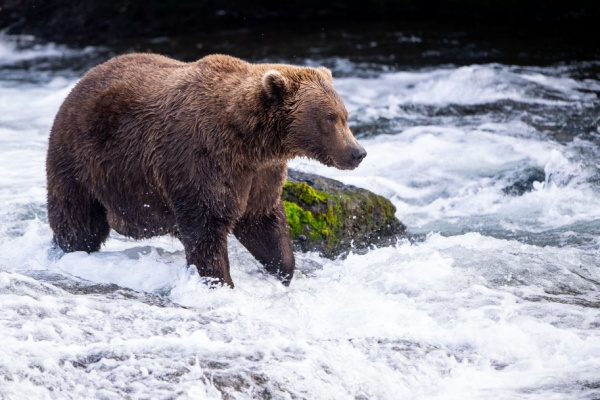
It was the survival of the thickest during Fat Bear Week and “Backpack” beat all odds to emerge as the fattest bear of 2026.
As USA Today reports, the medium-large adult male with blond ears and grizzled brown fur in late summer, beat out no. 910, an adult female, by 5,091 votes to emerge as the winner of the 12th edition of the annual beloved online showdown that celebrates Katmai National Park and Preserve‘s bears’ remarkable pre-hibernation glow-up.
But Backpack, no. 89, isn’t just some random bear out of the woods, no sir. This big boy is a legacy, the son of 2019 Fat Bear Week champion, Holly, who introduced him to Brooks River when he was a first-year cub in 2006. In his cub years, Backpack was often seen climbing onto his mother’s back when the pair swam in the river, earning him his name.
“After nearly two decades at Brooks River, Backpack’s journey from an injured cub riding on his mother’s back to a formidable adult male has made him one of the river’s most recognizable bears,” Fat Bear Week organizers said in a Sept. 29 news release. “In 2026, voters recognized that remarkable journey by choosing Backpack as the Fat Bear Week champion.”
The bear has a few visible wounds and scars and experienced a significant leg injury around 2007, though no one knows how it happened. However, he recovered from it the next year thanks to his mother’s care, separating from her in 2008. Since then, Backpack has grown into a large adult and become a consistent presence at Brooks Falls, especially in early summer, organizers said.
Unlike many large adult male bears, Backpack is not particularly aggressive toward his competitors, though he will not hesitate to stand up for himself when necessary.
“But he prefers to use a quiet strength to gain access to preferred fishing spots. His body size suggests that the strategy works,” the Fat Bear Week website said. “Backpack’s quiet toughness has allowed him to find his niche alongside the biggest bears at Brooks River.
What is Fat Bear Week?
Fat Bear Week is an annual celebration of Katmai’s brown bears as they reach peak weight heading into hibernation, according to the National Park Service.
The annual event, which began as Fat Bear Tuesday in 2014 and expanded into Fat Bear Week in 2015, is held at the Katmai National Park and Preserve in Alaska. Wildlife and bear enthusiasts from across the world are invited to participate in the event via live cams on explore.org, through which they can observe the bears in their natural habitats as they “feast on a banquet of Alaska wild salmon in one of the greatest salmon runs left on earth,” NPS said.
Record-breaking votes cast during Fat Bear Week
Voting for Fat Bear Week took place online, with winners advancing through a single-elimination bracket until one champion remained.
In 2026, Fat Bear Week ran Sept. 22-29, with voting taking place on all days except on the weekend from Sept. 26-27. Fans cast ballots in head-to-head matchups to decide which bear best embodies the survival skills and healthy appetite needed to make it through Alaska’s harsh winter months. “A record-breaking more than 2.5 million votes” were cast over the week, organizers said.
“This year, we honored resilience in our bears and in our nation, recognizing the landscapes, communities, and shared stories that connect us,” Katmai National Park said in a Sept. 29 post announcing the winner. “Thanks for being part of the journey. Until next year, enjoy the bears, salmon, and human connection that keeps Katmai’s ecosystems alive.”
The event is a partnership with Katmai National Park and Preserve, explore.org and Katmai Conservancy.
Which bears competed this year?
Organizers announced the bracket for this year’s competition on Sept. 18, saying finalists were narrowed from more than 100 bears that were spotted at Katmai National Park’s Brooks River in Alaska this year.
Park and preserve naturalist Mike Fitz, while announcing the bracket during a livestream, said the brown bears had reached “peak fat” and are ready to handle the long winter ahead. National Park Service’s Sarah Bruce said the bears were eventually selected from those who showed up at the river early in the summer and reappeared later in the season, allowing the team to take good before-and-after photos showing how many pounds the bears packed on while feasting on salmon over the summer.
How are the bears identified?
Katmai’s brown bears are assigned identification numbers by researchers and park staff so they can be tracked and monitored over time. Some of the best-known bears also have unofficial nicknames given by park watchers and staff, such as 32 “Chunk,” 164 “Bucky,” 151 “Walker” and 903 “Gully.”
Why do some bears have names?
All bears are officially identified by number. Nicknames are not assigned systematically, but some bears, particularly well-known males that frequently appear on bear cams or have distinctive behaviors and physical features, have acquired informal names from staff and fans. Female bears are less likely to have widely used nicknames, though some do. Their official identification numbers remain the primary way the park tracks individual bears.
—
Photo Credit: Tony Campbell / Shutterstock.com
