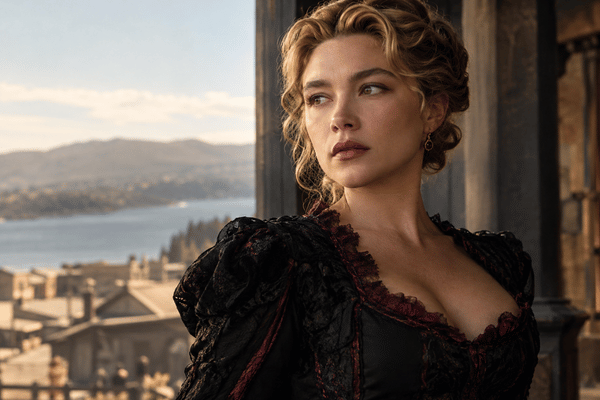
Florence Pugh’s transformation in Netflix’s East of Eden is being told through more than performance alone. Her costumes provide their own running commentary on Cathy Ames, a woman whose evolving appearance reflects a complicated journey from living inside other people’s expectations to deliberately creating an identity of her own.
The new adaptation of John Steinbeck’s novel was created by Zoe Kazan and puts Cathy at the heart of the sprawling story. That shift gives Pugh an especially rich character arc, and costume designer Kirsty Cameron found plenty of opportunities to express it through clothing.
Rather than treating period fashion as museum-piece decoration, Cameron approached the characters as people who would have considered themselves modern. Historical photographs of women going about everyday life provided valuable inspiration, while paintings helped establish the colors and textures that black-and-white photography could not.
Cathy’s earliest costumes immediately establish the tension between appearance and identity. As a girl, she is dressed according to the expectations of her family and the conventional future imagined for her. Visual references to Alice’s Adventures in Wonderland add another layer to those early looks, giving them an almost storybook innocence that sits uneasily beside the person Cathy will become.
As she grows older, her clothes increasingly reflect the roles imposed upon her or the identities she temporarily adopts.
During her relationship with Mr. Edwards, the wardrobe becomes heavier and more elaborate. Later, after Cathy enters Adam Trask’s life, she wears clothing that once belonged to his mother. The faded garments carry their own emotional baggage, reinforcing Adam’s tendency to see Cathy through the lens of an idealized woman from his past.
Her wedding dress provides another striking contrast. Several versions were considered before the production settled on a comparatively simple design. Elegant and restrained, it gives Cathy an unusual appearance of innocence at a moment when viewers already understand that there is far more happening beneath the surface.
California brings another shift. Cathy begins developing a stronger sense of personal taste even while continuing to play the roles demanded by her circumstances.
The most dramatic transformation arrives when Cathy becomes Kate.
Her initial appearance in the brothel helps her blend into her new surroundings, but that changes as her position changes. Once Kate takes control, the ornate clothing gives way to cleaner lines, darker colors and a more controlled aesthetic.
At that point, fashion is no longer simply something happening to her. It becomes something she uses.
The idea behind Kate’s later appearance even drew inspiration from Patti Smith and the power of creating an unmistakable personal image. Kate’s wardrobe becomes severe, sophisticated and deliberately sensual, with jewelry and keepsakes adding reminders of the men who have crossed her path.
That evolution makes the costumes an unusually revealing part of Pugh’s performance. Cathy begins the story wearing versions of womanhood constructed by other people. Kate eventually constructs one for herself.
Other characters receive their own carefully considered transformations, from Adam and Charles Trask to Abra and Lee, but Cathy’s journey offers the production its most dramatic fashion narrative.
In East of Eden, clothes do much more than establish a historical period. They reveal who has control, who is performing a role and who gets to decide what the world sees.
For Florence Pugh’s Cathy, that final question may be the most important one of all.
