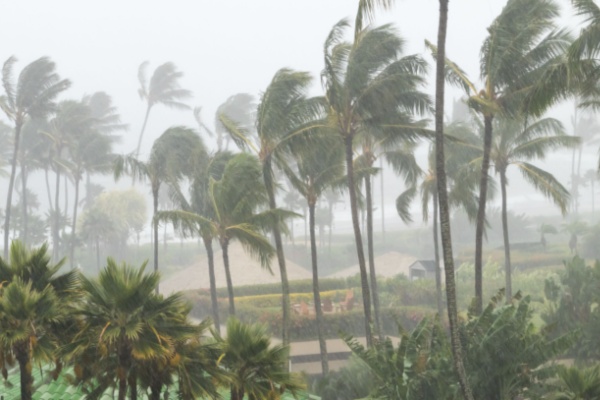
A rare hurricane warning is in effect for the Hawaiian islands of Kauai and Niihau as powerful Hurricane Lowell’s projected path ekes closer to the state. It’s the third storm in just over three weeks to target Hawaii, as El Niño supercharges the Pacific hurricane season.
As CBS News reports, Hurricane Lowell, a major Category 3 storm, approached western Hawaii early Monday with powerful 115-mph winds, triggering a hurricane warning for the islands of Kauai and Niihau. The National Hurricane Center also issued a tropical storm warning for the island of Oahu as Lowell tracked closer to land.
The hurricane warning extends to parts of the vast Papahanaumokuakea Marine National Monument, which covers almost 583,000 square miles of ocean and 10 of Hawaii’s islands. Lowell is expected to pass over portions of the national monument as it travels past the island chain.
The Miami-based hurricane center forecasts that Lowell’s center will move just west of the main Hawaiian Islands, near Niihau, on Monday night, then slow down by early Wednesday after passing them. “Gradual weakening is expected through Tuesday. However, Lowell is forecast to remain a hurricane as it passes near the Hawaiian Islands,” the center said.
Wind, Rain, Storm Surge, Flash Floods and Mudslides All Possible
Hurricane-force winds extended outward up to 60 miles from the storm’s center.
Lowell could bring huge amounts of rain to various islands, the hurricane center said, with forecasters estimating between 6 and 10 inches of rainfall for Kauai and, potentially, up to 16 inches in some areas. The Big Island could see 4 to 8 inches of rainfall, with up to 12 inches possible, while Oahu and Maui County could see 4 to 8 inches, with up to 10 inches possible depending on the location.
That rain could bring “significant” flash flooding and mudslides, especially in Kauai County and parts of Hawaii’s Big Island, the center stressed.
In addition, Lowell could hit Kauai County with a storm surge of up to 4 feet, according to the center, and bring “life-threatening surf and rip current conditions across many of the Hawaiian islands.” Up to a foot of storm surge could materialize on Oahu.
What’s more, several tornadoes could be spawned near Kauai and Niihau Monday afternoon through Monday night, the center said, and a few twisters are possible across the rest of Hawaii, the center pointed out.
After Lala, Hawaii Hunkers Down
As CNN Weather reports, Hawaii Gov. Josh Green declared a state of emergency for the entire state last week to free up resources and activate Hawaii National Guard units. Emergency personnel are being deployed to Kauai’s emergency operations center, the governor said Sunday, adding “airports and highways are securing facilities and equipment, and food and water have been positioned across Kauaʻi in case flooding or road closures isolate communities.”
Kauai County announced plans to close all parks and campgrounds and establish five refuge areas Sunday in anticipation of Lowell’s impacts. “Closing our parks and opening refuge areas is not a decision we make lightly, but it is the right call with a storm of this strength still turning toward us,” Mayor Derek S.K. Kawakami said in a statement. The mayor has signed an emergency proclamation ahead of the storm.
The Kauai Emergency Management Agency urged residents to stay home and off roads as conditions worsen, fill gas tanks, charge devices, and have enough water and food on hand.
Ahead of the storm, residents in Lihue, a town of 8,000 with Kauai’s primary airport, were stocking up on food and water as supermarket shelves emptied, according to the Associated Press. “We’ll lose some power, probably have some trees, a bunch of tree limbs coming down,” real estate agent Lori Benkert told the AP. “Everybody is probably going just to hunker down.”
El Niño’s Impact
El Niño is helping fuel increased storm potential in the central Pacific this year, warming ocean temperatures in the region and weakening storm-killing upper-level winds, on top of an ocean already warming from climate change.
Five named storms, including Lowell, have already either formed or tracked into the Central Pacific so far. A typical season only has five, but the National Oceanic and Atmospheric Administration’s (NOAA) forecast calls for up to 13 by the time this season is over.
—
Photo Credit: Ryan DeBerardinis / Shutterstock.com
