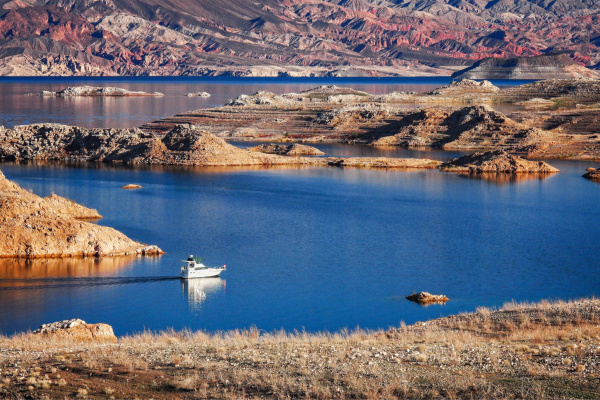
The United States’ largest reservoir, Lake Mead, has reached its lowest level on record as the drought-stricken West faces a growing water crisis.
As USA Today reports, the giant reservoir created by the Hoover Dam on the Colorado River outside Las Vegas dropped to a record-low elevation Aug. 7, reaching 1,040.5 feet. The lake provides water for tens of millions of American homes, businesses and farmers, along with carbon-free hydroelectricity. The previous all-time monthly low was recorded at 1,040 feet in July 2022, according to the Bureau of Reclamation.
Then on Aug. 13, Lake Mead dropped even further, to 1,039 feet elevation. It was also a foot below the all-time low on Wednesday, Aug. 12. As people look ahead at Southern Nevada’s water levels they may be wondering what will happen if Lake Mead’s water continues to deplete.
“It’s Grim and We Need to Do Something Fast”
“It’s grim and we obviously need to do something – and fast,” said Brad Udall, a senior climate scientist at Colorado State University’s Colorado Water Center.
The last time Lake Mead was near this low, in 2022, Sen. Mark Kelly, D-Ariz., warned of “drastic consequences for Arizona and other Colorado Basin states.” If levels at key reservoirs drop further, consequences could include the loss of hydropower generation and even “dead pool” conditions, in which no water would flow out of Lake Mead.
In 2022, low water levels in Lake Mead revealed sunken boats, the remains of towns that were submerged to make the reservoir, and several bodies.
Lake Mead is the source of drinking water for about 25 million people, of a total of about 40 million served by the Colorado River Basin, including the Las Vegas metropolitan area. The river also supplies irrigation water for about 5 million acres of agricultural land, including California farms providing a significant portion of the nation’s fruit and vegetables.
Long-term Drought is Exacerbated by Climate Change
Climatologists and other water supply experts say a long-term drought is being exacerbated by climate change, which is altering how much water falls on the Rocky Mountains as snow before melting into the Colorado River. The river serves seven Western states, Native American tribes and two northern Mexican states with water for agriculture, irrigation and drinking, hydroelectricity, recreation, and fish and wildlife habitat.
Water enters the 1,400-mile-long Colorado River as rain, snowmelt and runoff from the Rocky Mountains and flows through the Grand Canyon, down to Lake Powell, the nation’s second-largest reservoir, which is held back by the Glen Canyon Dam. The water flow powers Glen Canyon Dam’s hydroelectric turbines, then flows downstream to end up in Lake Mead, where it is distributed to lower basin states after again generating electricity.
And Then There’s Lake Powell
And then there’s Lake Powell, which is upstream of Lake Mead, which was 23.4% full on July 19. Powell hasn’t been full since 1983. If Powell’s water level falls more, that could create an environmental catastrophe by stopping the river from flowing through the Grand Canyon, a situation known as “dead pool,” which could cause energy and agricultural problems for some parts of the southwestern U.S.
Lake Powell is now at 3,521.43 feet and has fallen almost 4 feet in the past 30 days. Federal officials say it probably will hit its lowest level ever by early spring, if not sooner.
Because of extended drought, the combined water volume of Lake Mead and Lake Powell hasn’t been this low since before Lake Powell began to fill in 1963, according to the Department of Interior. The department’s letter introducing the environmental impact document states that the “risk to the system has never been greater.”
Everyone Needs to Agree to Use Significantly Less Water
Because the river and its reservoirs are insufficient to meet water demand, farmers and cities have been pumping groundwater from aquifers, which have been losing water at an increasing rate, according to NASA. Since 2002, the reservoirs and the aquifers have lost a combined 13.7 trillion gallons of water, according to recent NASA estimates.
Officials in the seven Western states have been battling over the river for more than a century, particularly as the West’s increasing population has demanded more water at a time of persistent drought.
The federal government issued a 10-year management plan and environmental impact statement to address water shortages in the Colorado River and plans to release additional details in the coming days. That plan calls for significant water-use cuts by California, Arizona and Nevada and voluntary reductions by Colorado, Wyoming, New Mexico and Utah.
Udall said the new federal plan is a solid start to addressing the issues he and others have been warning about for decades. But he worries too many people across the West believe the forecast super El Niño will bring significant relief to the area. The long-term trends, he said, remain dire, even if this winter is a wet one. He said Lake Mead’s future is “frightening” unless states, Native American tribes and the Mexican government can agree to use significantly less water.
“Mostly, I’m sad that we haven’t done more with all the knowledge we had,” Udall said. “We’re asking people to do really hard things. But failure to do them has completely unacceptable consequences. We are living on the edge.”
—
Photo Credit: CrackerClips Stock Media / Shutterstock.com
