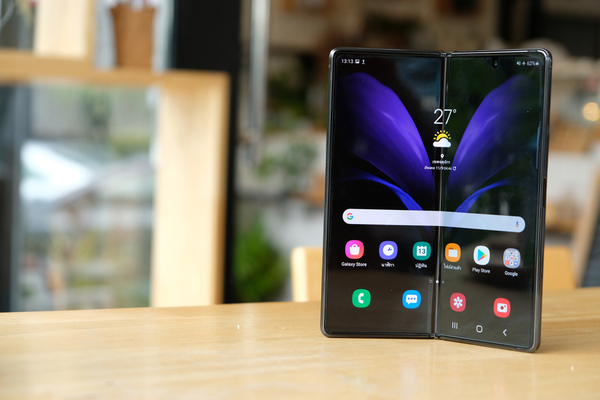
Samsung revealed its newest slate of foldables at this summer’s Galaxy Unpacked, which took place in London. In addition to a Galaxy Z Fold 8 that adopts a wider, passport-like form factor, Samsung showed off its new Galaxy Z Fold 8 Ultra with a crease you can barely see and a refreshed Z Flip 8, which has some new features for its cover screen.
As The Verge reports, there were new wearables as well, including the Galaxy Watch Ultra 2 that comes with a larger battery and a thinner case, alongside a Galaxy Watch 9 equipped with an upgraded chip. Samsung and Google revealed two new designs for their AI smart glasses launching later this year, too.
But truly, this year’s Unpacked belonged to the foldables.
Improved Specs in All the Right Places
As PCMag reprots, the Z Fold 8 Ultra is a book-style foldable, the same as it has been since its 2019 debut. The new name is necessary due to the lineup’s addition of the Z Fold 8, a passport-shaped folding phone that sits between the Z Flip 7 and the Z Fold 8 Ultra.
The Z Fold 8 Ultra features an Advanced Armor Aluminum frame with Gorilla Glass Ceramic 3 on the front and Gorilla Glass Victus 2 on the rear. It comes in Cream (white), Graphite (black), Green Shadow (online only), and Violet Shadow. The phone is IP48-rated for protection against dust larger than 1mm and submersion in up to about five feet of water for up to 30 minutes.
The phone is powered by the Qualcomm Snapdragon 8 Elite Gen 5 for Galaxy and comes with 12GB of RAM and 256GB, 512GB, or 1TB of storage. I was hoping to see Samsung boost the RAM to 16GB or more, but due to the skyrocketing memory costs, we all understand why it remained steady at 12GB.
The outer Dynamic AMOLED 2X screen measures 6.5 inches, has an FHD+ resolution, and a 120Hz adaptive refresh rate. The inner screen measures 8.0 inches and uses the same OLED panel tech and refresh rate as the outer panel.
Samsung boosted the battery to 5,000mAh, and it supports 65W wired charging and 20W Qi2 wireless charging, though it still requires a special case for magnetic wireless charging. Much more importantly, Samsung upgraded the battery from lithium-ion to silicon-carbon, which can be more efficient and longer-lasting.
For connectivity, it includes 5G (sub-6GHz and mmWave for US buyers), Wi-Fi 7, Bluetooth 6.0, and Ultra-Wideband. Let’s not forget support for eSIM as well as physical SIM cards. The trio of cameras includes a 200MP main shooter, a 50MP ultrawide, and a 10MP telephoto. You’ll get autofocus, optical image stabilization, 3x optical zoom, and 30x Space Zoom, in addition to 8K30 capture and editing.
To sum up, it’s a solid spec sheet that delivers the expected yearly upgrades.
It also includes Android 17 and includes One UI 9, the latest build from Samsung. Many of the new software features are AI-based and include things like the Now Nudge (prompts you to automatically add a calendar appointment, or open multitasking windows), the Now Brief (expanded daily recaps), Gemini Notebook (combines photos, notes, recordings, and more to create a single workspace), and more seamless task management between connected Galaxy devices.
What Makes the Z Fold 8 Ultra Special?
The Z Fold 8 Ultra measures 6.24 by 2.87 by 0.35 inches (HWD) folded and 6.24 by 5.64 by 0.16 inches unfolded. It weighs 7.58 ounces. These are the exact same dimensions as the Z Fold 7, making the phone thinner and lighter than many regular phones, let alone other folding phones. Despite the carried-over dimensions, the phone feels smaller and more comfortable to hold and use.
At a roundtable session in London, Samsung explained that it had softened all the edges. The Z Fold 7 has sharp edges all the way around. It’s a bit pointy and knife-like. For the Z Fold 8 Ultra, Samsung changed the curve radius along the Armor Aluminum frame to smooth things over. It’s a small change that has an oversized effect.
At the same time, Samsung has made the phone easier to open. It created a deeper bevel along the inner edge where the two halves meet, giving your fingers a bit more room to wedge in and pry the device open. Further, the hinge mechanism provides a bit more assistance, and the magnets are a bit weaker, reducing the force needed to open the phone by half. It’s hard to appreciate just how great this is unless you compare the two directly. The Z Fold 8 Ultra is far easier to open and close, and this is satisfying in its own way.
The screen may have the same size, shape, and resolution, but a few new bits of tech make a dramatic improvement. To start, it’s brighter. It jumps 11% a peak of 2,700 nits to a peak of 3,000 nits. It’s flatter. The revised hinge and display structure include a titanium backing that keeps the screen materials flatter, with a less-obvious crease. The reduced warping really enhances the display’s look and feel. It also has a new anti-reflective coating. In a side-by-side comparison, the Z Fold 8 Ultra is far easier to view under direct lighting, thanks to its new glare-reducing feature.
Is It Enough to Fend Off the Competition?
According to PCMag, while the overall package may not be all that different from its predecessor, the Z Fold 8 Ultra includes tasteful refinements that make a great phone even greater. It’s important to remember that this is the eighth generation of Z Fold, and Samsung has been developing the underlying screen tech for far longer. That gives it a huge advantage over companies like Apple, which have yet to enter the folding phone market (though it is rumored to do so soon).
Earlier this year, the Oppo Find N6’s incredible screen and appealing build impressed reviewers. Google’s Pixel 10 Pro Fold, while a fine phone, isn’t as technically impressive and is thick and heavy. The Motorola Razr Fold, meanwhile, stands in the middle as an alternative to Google and Samsung.
—
Photo Credit: Framesira / Shutterstock.com
