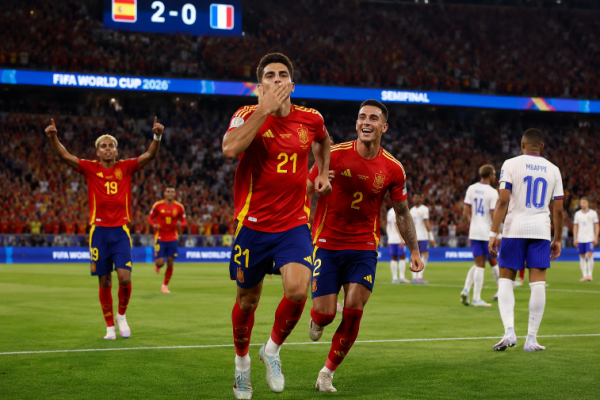
Spain returned to the top of world soccer on Sunday, defeating Argentina 1-0 after extra time in the 2026 FIFA World Cup final in East Rutherford, New Jersey.
Ferran Torres delivered the championship-winning moment in the 106th minute, breaking through an Argentina defense that had frustrated Spain for more than 90 minutes.
The decisive move began with a cross from Pedro Porro on the right. Nico Williams redirected the ball into Torres’ path, and the forward finished from close range to give Spain the lead.
It was the breakthrough Spain had spent most of the afternoon chasing.
Spain controlled possession and created the greater attacking threat, while Argentina concentrated on disrupting its opponent’s rhythm and protecting the area around its penalty box. The strategy kept the match scoreless through regulation, but it also left Lionel Messi and Argentina’s other attackers with few opportunities to influence the game.
Argentina’s task became even more difficult in second-half stoppage time when Enzo Fernández received his second yellow card and was sent off. That forced the defending champions to play all of extra time with 10 men.
Spain quickly took advantage. Less than a minute into the second extra-time period, Torres found the space that had been missing for much of the match and converted the chance that decided the championship.
Argentina mounted a late push and created several tense moments near the Spanish goal, but Spain’s defense held firm. When the final whistle arrived, the Spanish players celebrated the country’s second men’s World Cup title and its first since 2010.
The result also gave Spain a unique place in soccer history. With its women’s national team having won the 2023 World Cup, Spain became the first nation to hold both senior World Cup championships simultaneously.
Spain’s success was built on more than one decisive finish. Its defense allowed only one goal during the tournament, while a technically gifted midfield controlled matches with patience and precision.
Rodri was awarded the Golden Ball as the tournament’s outstanding player. Defender Pau Cubarsí received the young player award, and goalkeeper Unai Simón collected the Golden Glove.
For Argentina, the loss ended its bid to become the first country since Brazil in 1962 to win consecutive World Cups. It also brought an emotional conclusion to what could be Messi’s final appearance on the sport’s biggest stage.
Messi, 39, left the field without another championship, but his place in Argentina’s history was already secure. Spain simply made sure that this final belonged to a new champion.
