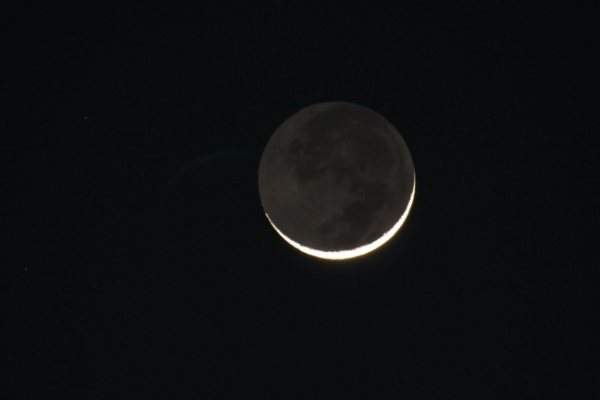
When the new Moon rises, or in the next few nights when the Moon is a slim crescent, go outside and look up. You might see Earth’s reflected light in the dim glow.
What is Earthshine?
According to NASA, a new Moon occurs when all of the Sun’s light is reflected away from Earth, and the side of the Moon facing Earth is barely visible, as illustrated in the above figures. Sometimes the dark face of the Moon catches Earth’s reflected glow and returns that light. The dark face of the Moon has a faint shine, a ghostly version of a full Moon. The phenomenon is called earthshine.
What Causes Earthshine?
As the Farmer’s Almanac reports, this occurs because 38 percent of the sunlight that strikes Earth bounces back into space; some of this earthlight bathes the lunar surface. About 10 percent of that light bounces off the lunar surface (which is not very reflective) to create the visible glow (Earthshine) on the Moon’s dark side.
The thinnest Moon crescents (both waxing and waning) display the brightest Earthshine. This is due to the phase reciprocity of the Earth and the Moon: When the Moon appears thinnest from Earth, Earth would look full from the Moon. Conversely, Earth would appear to be unlit, or in its “new” phase, if viewed from the Moon during what we would see as the Moon’s full phase.
But don’t be fooled: The portion of the crescent Moon that is illuminated by Earthshine appears to be part of a smaller orb than the sunlit crescent. This mirage is caused by our eyes’ response to the different light levels. It vanishes when you view the crescent through binoculars.
When is the Best time to View Earthshine?
It tends to be brightest between April and June, though it does occur at other times of the year. Earthshine is easiest to see around the time of a new Moon due to the position of Earth and the Moon in their orbits. Earthshine varies in strength throughout the year, since the light reflected from the Earth varies. Earth’s reflected light (albedo) is brightest in the Northern Hemisphere spring with a second, slightly smaller peak in the Southern Hemisphere spring.
Satellite measurements of energy reflected from the Arctic provide a picture of why earthshine peaks in the spring. During this period, the Northern Hemisphere is tilted towards the Sun and winter snow and ice are still on the ground in the higher latitudes. Because snow and ice reflect more light than vegetation or water, the spring is brighter than the summer or autumn, when there is much less snow and ice. During the winter, the Arctic receives very little sunlight and reflects less light. Clouds and sea ice contribute to the peak in the Southern Hemisphere.
An Inspiring Sight
According to the Almanac, historically, this was called “the new Moon in the old Moon’s arms.” You’ll also hear it as “the new Moon in the old Moon’s arms.” Earthshine is sunlight that’s taken a detour. Sunshine hits us, bounces to the Moon, then bounces back to our eyes to enable us to see it. It’s a three-way trip, making the glow on the Moon’s dark side “older” than the direct sunlight illuminating the brightly lit crescent.
That’s why, if the Sun were to blow up, the bright crescent would vanish first, but the dimmer Earthshine would linger for an additional 3 seconds—light’s round-trip time from Earth to the moon. As a result of all of the sun- and Earthshine bouncing, the crescent Moon’s earthlight is older than its sunlight. If the Sun were to go dark suddenly, the crescent Moon would disappear at the same time, but Earthshine would continue to illuminate the Moon faintly for 3 seconds.
Regardless of when you spot it, earthshine can be an inspiring sight. The phenomenon is captured in Neil Peart’s lyrics for Earthshine, featured on Rush’s 2002 album Vapor Trails. Peart often writes about scientific themes, including Countdown from Signals, which recounts the maiden launch of Space Shuttle Columbia. Earthshine begins by describing the orbital mechanics that make the phenomenon possible: “On certain nights, when the angles are right…”
This is unique in all the universe: Only the Moon is near enough to reflect back our own light for our narcissistic enjoyment.
—
Photo Credit: Khun Ta / Shutterstock.com
