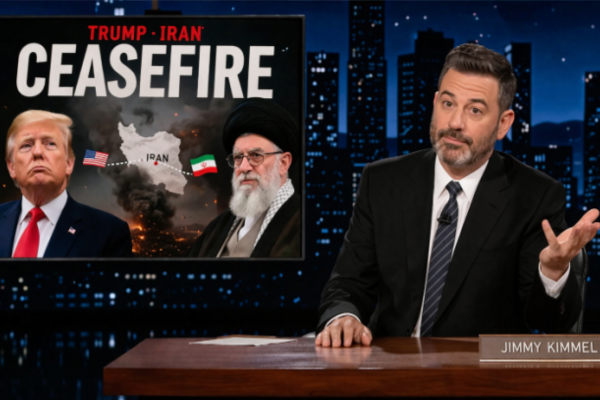
Late-night television once again found itself at the center of political commentary as Jimmy Kimmel turned his attention to President Donald Trump’s latest foreign policy move. The comedian used his platform to dissect a high-stakes moment involving the United States and Iran, delivering a mix of satire and pointed criticism.
The situation unfolded after Trump issued a stark warning to Iran, threatening significant military action tied to control of the Strait of Hormuz. The ultimatum raised global concern and intensified an already volatile geopolitical climate. However, in a last-minute shift, Trump announced a temporary two-week ceasefire, pausing what many feared could escalate into a broader conflict.
Kimmel seized on the sudden reversal. On his show, he portrayed the sequence as part of a familiar pattern, where bold declarations are followed by abrupt retreats. He highlighted past moments in which similar timelines and promises failed to produce the outcomes initially suggested, framing the latest development as more of the same.
The comedian’s commentary did not exist in a vacuum. Political leaders across the United States were already reacting strongly to the ceasefire announcement. Some welcomed the de-escalation, while others criticized the administration’s approach as reckless and destabilizing. The divide underscored the broader uncertainty surrounding the situation and the challenges of navigating international diplomacy under intense pressure.
Kimmel’s monologue blended humor with critique, reflecting a broader trend in late-night television where entertainment intersects with political discourse. By focusing on the perceived inconsistencies in Trump’s messaging, he tapped into ongoing public debate about leadership style and decision-making during moments of crisis.
As tensions remain unresolved and negotiations continue, the episode serves as a reminder that political actions increasingly play out not only on the global stage but also in the cultural arena, where comedians and commentators shape how those actions are perceived.
