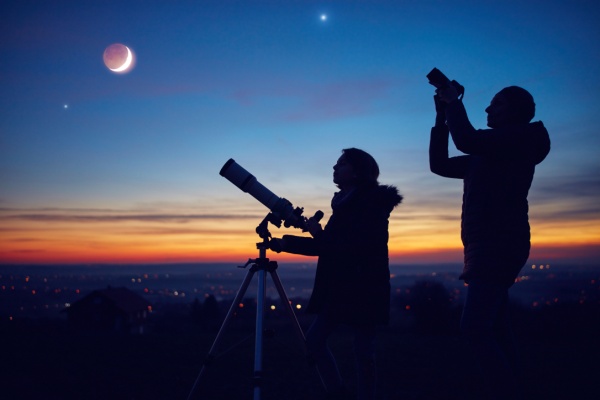
February’s widely promoted post-sunset “planet parade” or “planetary parade” reaches its most accessible this weekend.
Viewing the Planetary Parade
According to NASA, “Saturn, Venus, Mercury, and Jupiter will line up in the southwestern sky. With a telescope or binoculars, you can see Uranus and Neptune in the procession, too!” The space agency circles Feb. 28, 2026, as the night to stargaze.
The “parade” effect doesn’t mean the planets have formed a perfect straight line in space. NASA explains that the planets appear along a sky-line called the ecliptic because the solar system’s planets orbit in a relatively flat plane, and from Earth, that plane projects as an arc across the sky.
What makes nights like Feb. 28 special, NASA notes, is the chance to catch many planets at once — including quick-hitting Mercury — in a single sweep of the evening sky.
NASA says four of the six should be visible without a telescope if conditions cooperate, but for the faintest planets, you’ll need a telescope. NASA notes that Uranus is dim and Neptune is much fainter, and that Mercury can also be challenging because it stays close to the horizon in twilight.
NASA’s February skywatching guide breaks the scene into a few landmarks. The best viewing window will be 30-45 minutes after sunset, facing west-southwest. In the west-southwest sky, NASA says Venus and Mercury climb upward after sunset, while Saturn drops closer to the horizon.
NASA also notes Jupiter will be high in the sky, with Uranus in the southern sky and Neptune near Saturn — though Neptune will require a telescope to see. NASA emphasizes that how high an object sits above the horizon can make or break visibility: the lower it is, the more atmosphere you’re looking through, and the easier it is for terrain, trees, and buildings to block your view.
So pick a spot with a clear view toward the west and southwest, step outside shortly after sunset, and count what you can — bright Venus and Jupiter first, then the more elusive planets as the sky darkens.
What You Can See Easily, and What You Can’t
But as Forbes reports, it’s important to keep expectations low. Six planets may be above the horizon — Venus, Mercury, Saturn, Neptune, Uranus and Jupiter — but visibility varies sharply. In practical terms, this weekend’s reliable naked-eye planets are Venus (briefly) and Jupiter (all evening). Saturn, Mercury and Uranus are possible with binoculars or a telescope, while Neptune is effectively out of reach.
Some of the lineup will be straightforward: NASA identifies Venus and Jupiter as bright, reliable targets for most observers, while Saturn is visible but lower in the sky this month. For the harder pair, NASA’s skywatching guidance is more specific: Neptune “absolutely requires a telescope,” while Uranus is faint enough that binoculars or a telescope are typically needed to pick it out.
However, this weekend remains the best opportunity for casual stargazers to grab a glimpse of at least some of the six planets. After this weekend, Mercury effectively disappears while Saturn slides deeper into twilight ahead of its conjunction with the sun next month. Jupiter will continue to dominate the night sky for the next few months, while Venus slowly climbs higher each evening in the coming weeks, peaking in late summer.
What’s Next In The Night Sky
A far easier and more impressive sight than the “planet parade” comes on the night of March 2-3, when a total lunar eclipse will turn the full worm moon a copper-reddish color for 58 minutes for observers across North America, the Pacific, Australia, New Zealand and east Asia. It will surely be one of the most dramatic naked-eye night sky events of 2026.
—
Photo Credit: True Touch Lifestyle / Shutterstock.com
