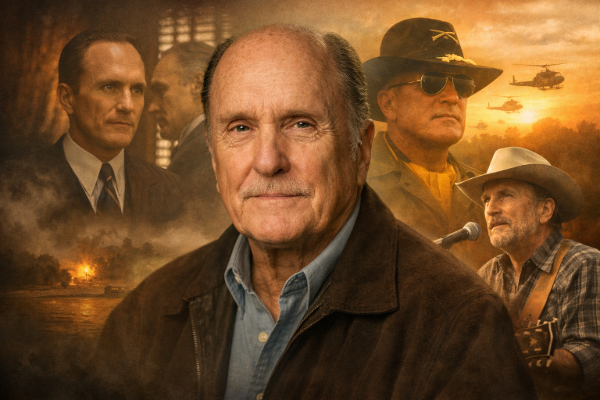
Robert Duvall, one of the most respected and enduring actors in American film history, has died at 95. According to his publicist and a statement from his wife, Luciana Duvall, he passed away peacefully at his home in Middleburg, Virginia.
For more than six decades, Duvall built a career defined by discipline, range, and an almost surgical precision in performance. He may not have fit the traditional mold of a leading man, but few actors matched his ability to disappear so completely into a role. From quiet authority figures to explosive military commanders, Duvall brought intensity and truth to every character he portrayed.
His breakthrough came in 1972 with his portrayal of Tom Hagen in “The Godfather,” directed by Francis Ford Coppola. As the steady, sharp-minded consigliere to the Corleone family, Duvall anchored scenes with understated control. He reprised the role in the sequel, further cementing his place in Hollywood’s upper tier. A salary dispute later kept him from returning for the third installment, a decision that remained a point of discussion among fans and critics alike.
Duvall demonstrated his ability to command the screen in a vastly different way in “Apocalypse Now.” As Lt. Col. Bill Kilgore, he delivered one of cinema’s most unforgettable performances, embodying the swagger and chaos of war with chilling conviction. The role earned him another Academy Award nomination and became part of film lore.
In 1984, he won the Academy Award for Best Actor for “Tender Mercies,” portraying a washed-up country singer searching for redemption. The performance was restrained yet deeply emotional, revealing the quiet strength that became a hallmark of his work.
Over the years, Duvall collected seven Oscar nominations, four Golden Globe Awards, and in 2005 received the National Medal of Arts. His résumé stretched across genres and generations, with memorable roles in “The Great Santini,” “Network,” “True Grit,” “M-A-S-H,” “The Apostle,” and later films including “The Judge,” “Widows,” and “12 Mighty Orphans.”
His commitment to authenticity extended beyond acting. For “The Apostle,” he spent more than a decade developing the script, visiting churches throughout the South before writing, directing, producing, and starring in the film. The project earned him another Academy Award nomination and reinforced his reputation as a craftsman first and a celebrity second.
Born in 1931 in San Diego and raised in Navy towns including Annapolis, Duvall grew up observing the disciplined world of military life. His father was a Navy admiral, and those early experiences would later inform several of his portrayals of complex military figures. After serving two years in the Army, he used the G.I. Bill to study at the Neighborhood Playhouse in New York, alongside future stars Gene Hackman and Dustin Hoffman.
Away from the spotlight, Duvall pursued directing and nurtured a deep love for tango, which eventually inspired the film “Assassination Tango.” In 2005, he married Luciana Pedraza, who survives him.
Robert Duvall’s career was not built on flash but on focus. He stayed hungry for the work, choosing roles that challenged him and committing fully to every character. In doing so, he left behind a body of work that continues to define American cinema.
