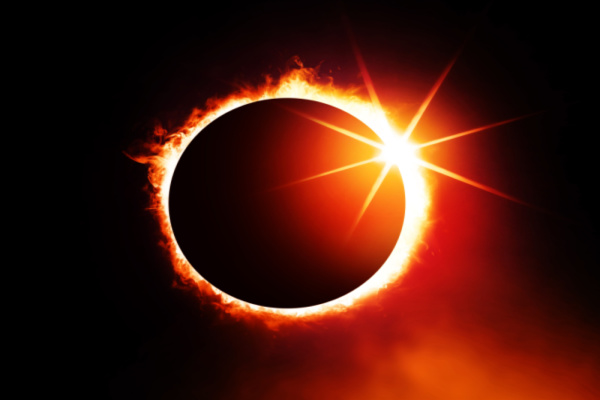
The first annular solar eclipse is here.
As Space.com reports, an annular solar eclipse occurs when the moon passes directly in front of the sun’s disk during the new moon phase while at a distant point from Earth in its elliptical orbit. Around this time, the lunar disk appears slightly smaller than the sun in Earth’s sky. As a result, a sliver of the sun can be seen surrounding the moon during annularity — the equivalent to totality during a total solar eclipse.
Why is it a Ring of Fire?
On Feb. 17, 2026, an annular solar eclipse will be visible from a remote part of Antarctica, forming a “ring of fire” for up to 2 minutes, 20 seconds as 96% of the sun’s center is eclipsed by the moon. During an annular solar eclipse, the moon covers a majority of the sun, leaving a distinct ring of light, hence the nickname ‘ring of fire’ eclipse.
Where will the Eclipse be Visible?
Perhaps the best place to be on Feb. 17, 2026, will be Concordia, a joint French-Italian research station that opened in 2005 and houses just 16 scientists. It’s one of only three stations in the interior of the Antarctic continent. It can get as cold as minus 112 degrees Fahrenheit (minus 80 degrees Celsius) outside; it’s one of the coldest locations on Earth.
Unfortunately, the eclipse path for the Feb. 17, 2026, annular solar eclipse will be limited to this remote region of Antarctica, so the event will be seen by almost no humans. If you can wrangle some time off and manage to make the trek and witness this event, bragging rights will be well deserved. Practically speaking, though, that will be difficult unless you happen to be working at some select research stations in Antarctica.
“It’s possible that only a few people will view this eclipse from within the annular zone,” eclipse meteorologist Jay Anderson wrote on his website, Eclipsophile.com. “It’s a challenge to reach and there are only two inhabited locations within the annular shadow, neither of which is set up to welcome tourists.”
However, mid-February is toward the end of the cruising season in Antarctica, and a well-timed cruise to locations in the Antarctic Peninsula could give you a glimpse of a partial solar eclipse. A partial solar eclipse will also be visible from southeastern Africa.
3 Fun Facts about Solar Eclipses
To mark this precise celestial alignment — and the orbital choreography behind it — here are three fascinating facts about solar eclipses you might not know.
1. Not all “ring of fire” eclipses look the same.
The thickness of the glowing ring depends on how far the moon is from Earth. During this annular solar eclipse, the moon will be near its farthest point, making the ring appear especially bright and narrow.
2. Eclipses only happen during short seasonal windows
Even though we get a new moon every month, eclipses are only possible during eclipse seasons, which occur roughly twice a year when the moon’s orbit lines up with the sun and Earth.
3. Solar eclipses are slowly changing over time
The moon is drifting away from Earth at about 1.5 inches (3.8 centimeters) per year. Far in the future, total solar eclipses will disappear, leaving only annular and partial solar eclipses behind.
—
Photo Credit: ssuaphotos / Shutterstock.com
