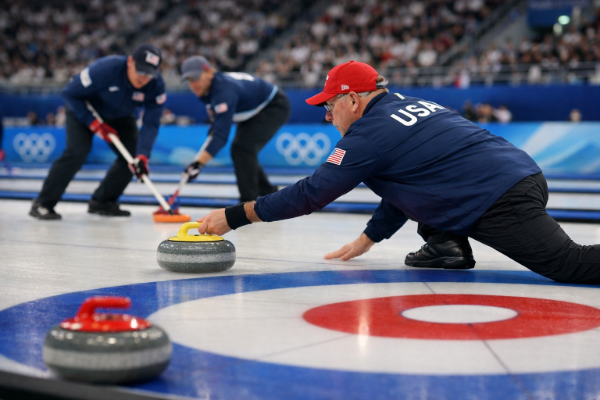
When the U.S. men’s curling team found itself trailing Switzerland 8-2 in the final end of its Olympic round-robin opener, the competitive stakes had largely faded. What remained was opportunity.
The Americans called for a substitution, and 54-year-old alternate Rich Ruohonen stepped onto the ice. Moments later, he calmly delivered a corner guard that settled safely along the left flank of the house. Teammates erupted. Fans rose to their feet. And with that single throw, Ruohonen etched his name into the record books as the oldest American to compete at a Winter Olympics.
Skip Danny Casper, three decades younger than Ruohonen, shouted his approval from across the sheet. The celebration may have come in a lopsided loss, but for the veteran curler from Brooklyn Park, Minnesota, the moment carried weight well beyond the scoreboard.
Ruohonen’s journey to the Olympic stage has been anything but conventional. By day, he is a personal injury lawyer and six-time Minnesota Attorney of the Year recipient. By early morning and late evening, he is a dedicated athlete chasing a dream that narrowly eluded him several times before.
Three days a week, Ruohonen rises at 5 a.m., leaves home before sunrise and drives 30 miles to train. Afterward, he puts in a full day at his law practice before returning to the ice for evening sessions. From Thursday through Sunday, he competes in tournaments, often bringing a collared shirt and tie along so he can handle court hearings via Zoom between matches.
His Olympic opportunity came after he joined the team as an alternate for Casper, who has Guillain-Barre syndrome. Over time, Ruohonen became more than a roster addition. Teammates describe him as a mentor figure, transporting players in his truck, waking them for practice and stocking up on snacks. In press conferences, they joke about his legal career, playfully offering his services to anyone in need of representation.
Behind the humor is mutual respect. Ruohonen represents a bridge between eras. He recalls earlier days in the sport when conditioning was less rigorous and athletes relied more on feel than fitness. Looking at his current teammates, he sees a different model: stronger, leaner and intensely disciplined.
It was this younger generation that helped secure Olympic qualification, defeating veterans from Ruohonen’s own era. And it was that same group that ensured he would finally experience the Games firsthand.
The scoreboard may not have favored the Americans that afternoon, but the scene inside the arena told a different story. For one throw, one ovation and one milestone, Rich Ruohonen’s long pursuit of Olympic ice came full circle.
