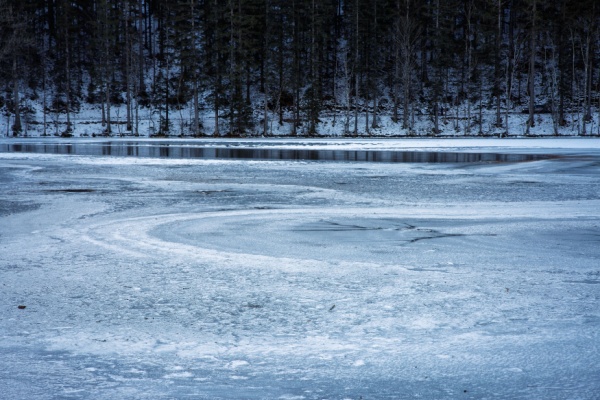
From above, ice rings appear like a bull’s-eye, creating intricate circular patterns on lakes and ponds. Experts say this striking winter phenomenon only forms under the right set of weather conditions.
As AccuWeather reports, the breathtaking phenomenon, known as ice rings or ice swirls, was spotted just last week in drone video over a frozen lake near Budapest, Hungary, where temperatures have recently been in the upper teens and low 20s and snow has been a regular occurrence.
Similar ice rings were captured on Mirror Lake in New Hampshire in 2020 by a delighted nature photographer while ice skating.
What Makes an Ice Ring?
Experts say giant ice rings form on lakes or other large bodies of water through a combination of cold weather, snow and ice. According to Dr. Gordon Giesbrecht, an environmental physiologist at the University of Manitoba, the process begins when the ice sheet is thin enough to allow snow to break through and become saturated with water.
“The rings probably form one at a time starting from an ice star at the center. The rings appear to be a result of water flowing up through the most recently formed ring crack and radially outward until the weight of the slush breaks the black ice layer,” Giesbrecht wrote on his blog. “By then, there is enough weight has built up to crack the ice at the edge of the newly saturated ring. The new crack allows the water to flow up and repeat the process.”
Giesbrecht said individual “bull’s-eye” rings could form in under a minute, based on how quickly fluffy snow becomes saturated with water. The result is a stunning winter scene that appears to have been created with a paintbrush.
—
Photo Credit: BalkansCat / Shutterstock.com
