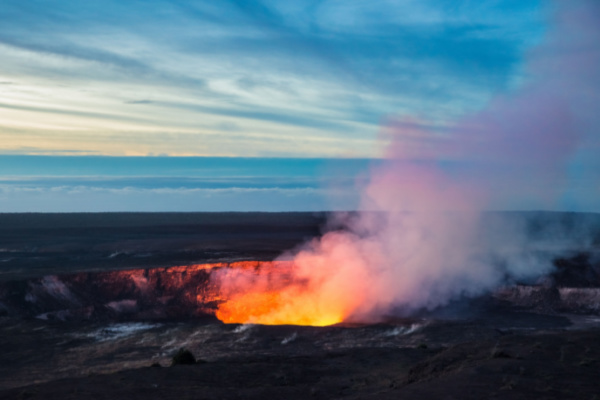
Hawaii’s Kilauea volcano, designated as one of the world’s most active, began its latest “eruptive episode” on January 12. This will mark the volcano’s 40th eruption since December 23, 2024.
According to the USGS, the volcano is currently at a Volcano Alert Level of “Watch” and an Aviation Color Code of “Orange.” This designation indicates heightened volcanic unrest with an increased potential for an eruption, or an eruption that poses limited hazards, typically with none or only minor volcanic ash emissions.
For this current eruption, the USGS states that “ground-level sensors near the eruptive vents indicate that winds are light at the summit, less than 5 mph (2 m/s), and variable in direction. This makes it difficult to predict how the eruption plume will spread during this episode, but it will probably remain closer to Halemaʻumaʻu and the summit.”
The USGS monitors Kīlauea closely through the Hawaiian Volcano Observatory (HVO), using various “marks” or data points like webacam imagery (showing glow/fountains), fround deformation (tiltmeters), earthquake swarms, gas emissions (S02), and eruption episode tracking (i.e. Episode 38, 39, 40, etc.) within the Halemaʻumaʻu crater, issuing alerts (Watch/Advisory) and updates to inform the public about ongoing volcanic activity.
Key USGS Monitoring Methods & “Marks” for Kīlauea:
- Webcams & Visuals: HVO uses summit webcams to show lava fountains, glow, and changes in the crater, like the silvery patch of lava seen in late 2024.
- Ground Deformation (Tilt): Tiltmeters measure inflation (magma recharging) and deflation (magma erupting) of the summit, with colored fringes on interferograms showing ground movement.
- Earthquake Activity: They track earthquake frequency, depth, and magnitude (M) to understand magma movement.
- Gas Emissions: Monitoring sulfur dioxide (
SO2cap S cap O sub 2𝑆𝑂2) reveals the volcano’s unrest and contributes to vog (volcanic smog) forecasts.
- Eruption Episodes: Kīlauea’s current activity involves episodic fountaining from vents (north & south), tracked with episode numbers and start/end times.
- Alert Levels: The USGS assigns alert levels (e.g., WATCH) and aviation color codes to communicate hazard status.
In essence, the “mark” is the continuous stream of scientific data and alerts from the HVO, indicating Kīlauea’s changing behavior.
Where to Find Current “Marks”:
- Visit the USGS Hawaiian Volcano Observatory (HVO) website for the latest updates, volcano messages, photos, and monitoring data.
- Three Kīlauea summit livestream videos that show eruptive lava fountains are available here: https://youtube.com/@usgs/streams.
What Does This All Mean?
Although the Kilauea volcano has been listed as “in a constant state of eruption” since 1983, this latest string of eruptive activity has certainly been impressive. According to NASA, beginning in December, 2024, even more intense surges of activity began to occur in Halema‘uma‘u every few weeks, usually in the form of huge lava fountains that lasted for several hours.
One recent eruptive episode, the 37th since December 2024, produced fountains that soared up to 1,000 feet (300 meters), while plumes of particles and volcanic gases swirled into “volnados” that wowed onlookers in November 2025. On December 6, 2025, the 38th episode produced a lava fountain that sprayed beyond Halemaʻumaʻu’s rim and destroyed a U.S. Geological Survey camera site.
“The height of the fountaining we’ve started to see at Halema‘uma‘u is amazing,” said Ian Flynn, a volcanologist at the University of Pittsburgh. Scientists are seeing a surge in volatile-rich magma coming from the volcano since December 2024. This means the magma has more dissolved gases, causing it to rise and “fizz” as it erupts from the surface, much like a shaken bottle of soda, he added. According to MODVOLC data, these frequent spikes in activity often push Kīlauea’s spectral radiance to double or triple the baseline levels prior to the 2018 LERZ eruption.
It’s unclear what Kīlauea’s future will bring. For the past 200 years, relatively gentle effusive eruptions have dominated, but the geologic record makes clear that Kīlauea cycles into periods of more explosive eruptions, as occurred between 1500 and 1800, when groundwater mixed with magma and made eruptions much more violent.
It is unknown when a similar transition will occur, but whatever happens, scientists will analyze how new developments compare to the volcano’s past behavior.
—
Photo Credit: Alexander Demyanenko / Shutterstock.com
