CES is always a showcase for wacky smart home devices, but PCMag’s favorites this year combine cool technology with practical upgrades.
As PCMag reports, the best products don’t just add features but expand how useful their respective categories can be. In some cases, they lower the barrier to entry for either setting up, connecting, or maintaining your smart home. It’s an interesting and exciting shift. For years, companies have talked about building a seamless smart home that just works, and now, we might actually be getting there.
Here are the best smart home products from CES 2026, according to PCMag editors.
Roborock Saros Rover
Roborock did it again, this time by adding robot legs to its vacuum instead of last year’s robot arm. While the arm didn’t prove to be a practical upgrade in testing, the legs offer a distinct usability advantage over every other robot vacuum. They can climb stairs and clean as they climb.
Roborock Saros Rover showed off its action at CES. The legs operate independently to raise and lower each side as necessary. They can help the bot clear obstacles and even navigate slopes. When climbing steps, one leg stays on the step below as a brace, while the rest of the vacuum slides along the surface to get the staircase clean.
Ring Smart Sensors
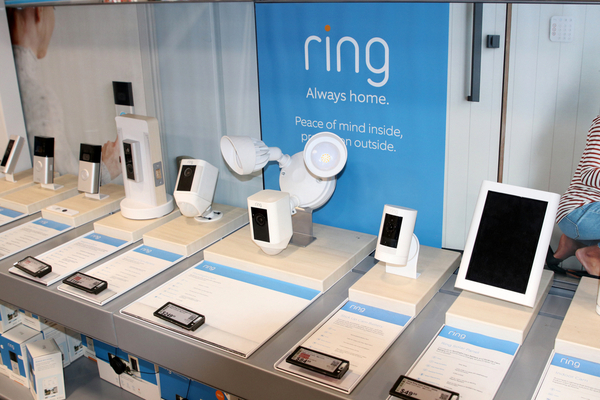
To set up any of the sensors in Ring’s new lineup, you place them where you want them, add them to your app, and you’re done. The sensors connect to Amazon’s Sidewalk service automatically, so you don’t need to establish a connection to a personal hub or even your own Wi-Fi. Because of that Sidewalk signal, they should work at a wide range around your property if you need to place a device far from your router.
Sidewalk works by reallocating a small portion of the Wi-Fi signal from participating customers and sending it over long distances. After taking a couple of years to get established, the company notes that coverage is now comparable with cellular service and is ready for practical applications, such as connecting these sensors. Ring’s offerings include options for protection, such as motion sensors, safety features like flood detectors, and control options like smart plugs.
Lockin V7 Max
A Best of CES nominee, the Lockin V7 Max is a smart lock that stays charged indefinitely, without needing fancy wiring or a solar panel with access to regular sunlight. Using wireless optical charging in a process the company calls Auracharge, the V7 Max maintains power through infrared beams sent from a nearby device. You plug in a transmitter within 13 feet of the lock, and this transmitter shoots the beam to a small receptor on the panel of the interior escutcheon. The eye-safe optical output has been certified for safety by two different global services, and the beam is tuned to provide stable, efficient, and fast power.
The lock itself has plenty of features aside from the unique power source. It has a pair of cameras on the outside, so it doubles as a video doorbell. It also has a touch screen on both the outside and inside of the door. You can unlock it with your fingerprint, palm, or face, and it has AI built into the camera to recognize faces and events.
Lockin hasn’t announced an official price for the V7 Max, but a company rep estimated it could cost as much as $1,300, which is multiple times more expensive than our current favorite options. The V7 Max should be available this summer, but the company will also add AuraCharge to the more affordable $350 Veno Pro.
GE Profile Smart Fridge
Thanks to a built-in barcode scanner, the GE Profile Smart Fridge can help make sure your shopping list stays up-to-date. Scan your item when it’s run out, and the fridge will add it to a running tally that you can check on the touch screen of the fridge itself or on the company’s app, so you know what to pick up when you’re at the store. The fridge’s database can already recognize four million different barcodes, and you can manually enter items that it doesn’t recognize.
Aside from the barcode scanner, the fridge has an interior camera that snaps pics of your fruit and vegetable drawers, so you can check the app and make sure your berries still look good before deciding whether to buy more. The water dispenser can also automatically fill your glass and stop when it’s full, and distribute a measured amount of water for cooking. The GE Profile Smart Fridge will be available starting in April for $4,899.
Lutron Smart Blinds
Like other smart blinds, these window treatments from Lutron connect to an app and let you open and shut them with your phone or with a voice command. These models separate themselves by automatically adjusting their angle throughout the day to let in pleasing natural light and block harsh rays.
Called Natural Light Optimization, the Lutron Smart Blinds change their position automatically throughout the day based on which way your window is facing, as well as your location. They don’t detect the actual presence of light, so they might pivot even if it’s not a sunny day, but they do change their patterns based on the time of year and the corresponding pattern of the sun. They’ll close at dusk for privacy, and pivot to block midday rays that could blind you or cause your furniture to fade over time.
They work on disposable batteries, but those batteries supposedly last for years at a time. Starting at $429, the Caseta smart wood blinds are available to order now and are priced competitively considering their functionality. That said, replacing an entire home’s worth of window treatments would be pricey.
Robotin R2 Pro
Another Best of CES nominee, Robotin’s modular concept doesn’t just vacuum your carpets, it also shampoos, washes, and dries them. It’s the first robot vacuum that actually deep cleans carpets as it works. It can supposedly wash and dry up to 400 square feet in roughly three hours. If you just want it to vacuum and mop and speed up the process accordingly, you can swap in a different module meant for those tasks. The modules form the bulk of the robot, and snap onto a base that includes the wheels and the front of the body housing the navigation technology.
At launch, the Robotin R2 Pro will ship with the deep cleaning module, the module that vacuums and mops, and the base station to recharge the bot. More modules will follow, including one with a robot arm. The company hasn’t declared a price, but it’ll be somewhere in the typical premium range between $1,000 and $1,500.
LG CLOiD
The last entry on this list is admittedly more centered around wish fulfillment than practicality, but the LG CLOiD is an extremely cool concept. It’s a humanoid robot with big wheels for mobility, a face with a camera and expressions, a torso that raises and lowers, and arms that can rotate and bend and grip objects with its fingers. LG CLOiD can interact with other LG appliances to start the dishwasher or preheat the oven, and it can otherwise help around the house by doing chores. It can switch the laundry or fold it when it’s done. It can unload the dishwasher, grab ingredients from the fridge, or even help out with cooking by mixing items together into a bowl.
Most of these promised features weren’t ready yet during the CES demo, and LG CLOiD is still a prototype. When the dust settles, CLOiD might end up being just another piece of CES vaporware, but it would be the closest thing to an actual Rosie the Robot if it does come to fruition.
—
Photo Credit: Eric Glenn / Shutterstock.com
