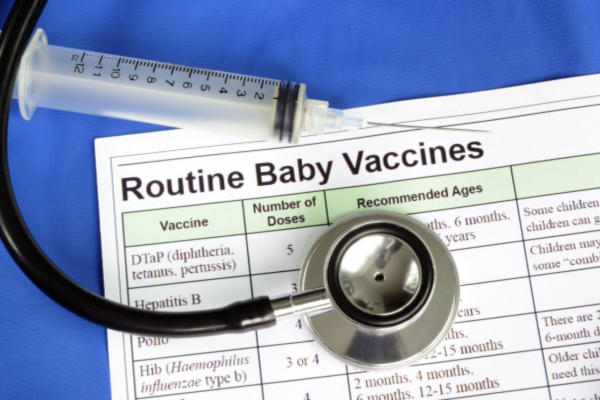
The Centers for Disease Control and Prevention (CDC) announced on Monday it is changing the childhood immunization schedule.
As ABC News reports, the federal health agency – led by vaccine skeptic Robert F Kennedy Jr – is removing the universal recommendation for multiple shots, in what it calls an attempt to mirror the schedules of peer countries.
Instead of being universally recommended for almost all children at certain age cut offs, vaccines are now split into three categories: vaccines for all children, vaccines for certain high-risk groups and vaccines based on shared clinical decision making.
Which Vaccines are Affected?
The CDC recently eliminated universal recommendations for six immunizations, shifting them to a “shared clinical decision-making” model for high-risk children, including vaccines for Rotavirus, Influenza (Flu), COVID-19, Meningococcal disease, Hepatitis A, and Hepatitis B.
The CDC still universally recommends vaccines for Measles, Mumps, Rubella, Diphtheria, Tetanus, Pertussis (DTaP), Polio, Hib, Pneumococcal disease, and Varicella (chickenpox).
What does “Shared Clinical Decision Making” Mean?
Shared clinical decision making is the term used by CDC to imply that patients, and parents, should talk to their provider about whether they should be vaccinated.
For children not in certain high-risk groups, no vaccine is recommended before the age of two months.
The change comes after President Donald Trump signed a memo in early December last year directing Health and Human Services (HHS) Secretary Robert F. Kennedy Jr. to examine how other nations structure their childhood vaccine schedules.
How will the Change Affect Health Insurance Coverage?
HHS officials say the change will not affect health insurance coverage of vaccines. “President Trump directed us to examine how other developed nations protect their children and to take action if they are doing better,” Kennedy said in a statement.
“After an exhaustive review of the evidence, we are aligning the U.S. childhood vaccine schedule with international consensus while strengthening transparency and informed consent. This decision protects children, respects families, and rebuilds trust in public health.”
However, many skeptics say that the extension of coverage promised by the Trump Administration will only apply to 2026, and the insurance companies have no requirement to extend it after that.
The Medical Community Condemns the Decision
The changes drew rebuke from doctors, who have universally condemned the decision, saying that it was “ideologically motivated,” and ignores decades of proven scientific research. They state that such a change did not undergo further debate by medical experts before being implemented.
The CDC’s vaccine advisory committee met last month to discuss the childhood vaccine schedule, but only voted to remove the universal recommendation for the hepatitis B vaccine at birth.
“I thought there might be proposals that were debated amongst experts in a public meeting, and then maybe something like this resulting from that, but not in the way this has been done, where a new schedule is released, which has already been signed on to by all the health advisors for the president,” Dr. Dave Margolius, an internal medicine physician and director of public for the city of Cleveland, told ABC News.
Dr. Demetre Daskalakis, former director of the CDC’s National Center for Immunization and Respiratory Diseases, said altering the schedule without consulting U.S. experts in pediatrics, infectious diseases and public health “undermines both scientific rigor and transparency.”
He told ABC News that the American health care system is unique, which makes it difficult to align the U.S. vaccine schedule to those of peer nations. “Vaccine schedules should be crafted to reflect the specific patterns of disease and access to healthcare in the United States; unfortunately, these vital factors were not adequately considered in the development of the new schedule,” Daskalakis said.
Federal Government Can No Longer Be Trusted to Protect American Children from Vaccine-Preventable Diseases
In a press briefing representing the American Academy of Pediatrics (AAP), Dr. Sean O’Leary, an infectious disease physician and chair of the AAP Committee on Infectious Diseases, said the federal government can no longer be trusted in its role to protect American children from vaccine-preventable diseases.
“Tragically, our federal government can no longer be trusted in this role,” O’Leary said. “Unfortunately, our government is making it much harder for pediatricians to do our jobs, and they’re making it much harder for parents to know what to do.”
O’Leary confirmed the AAP was not consulted by HHS ahead of this decision to change the vaccine schedule.
Additionally, Sen. Bill Cassidy (R-La.), a physician and chair of the Senate’s health committee, distanced himself from the CDC’s decision to change the childhood vaccine schedule. “Changing the pediatric vaccine schedule based on no scientific input on safety risks and little transparency will cause unnecessary fear for patients and doctors, and will make America sicker,” Cassidy wrote in a post on X, rejecting the recent changes.
Cassidy added that the schedule is “not a mandate,” but rather a recommendation that gives parents the “power” to choose which vaccines their children receive.
—
Photo Credit: JohnKwan / Shutterstock.com
