Just in time for holiday family gatherings, multiple measles outbreaks have surged across the United States. Reported cases are accumulating nearly as quickly as when the West Texas outbreak was at its peak this spring.
There were 84 new measles cases reported in the past week nationwide, according to data posted by the US Centers for Disease Control and Prevention (CDC). That’s more cases than have been reported in a single week since April, when there was an average of about 100 new cases per week.
Texas has Leveled, but South Carolina, Utah and Arizona are Surging
Although Texas hasn’t reported any new measles cases since state officials declared that the outbreak there was over in mid-August, now the case counts are growing quickly in South Carolina, where state health officials say more than 250 people are in quarantine after possible exposure and 16 are in isolation because of illness.
Most of the cases are in the upstate region, near Greenville. The state has reported dozens of new cases since Friday, with most coming from an exposure at a church. Exposures have also occurred at schools and medical settings.
Some of them are in quarantine for a second time because they did not acquire additional protection — through vaccination or natural immunity from an infection — since the first exposure, state epidemiologist Dr. Linda Bell said at a briefing. New cases are also adding up at an accelerating pace, she said.
“This is a reminder that the maximum incubation period for measles is 21 days, so for any student or anyone to have to go through that quarantine period twice, that’s a significant amount of time,” Bell said. “Vaccination continues to be the best way to prevent the disruption that measles is causing to people’s education, to employment and other factors in people’s lives in our communities.”
Measles cases also continue to accumulate in Utah and Arizona, where an outbreak along the state line has been growing for months. Arizona has reported 176 cases as of Tuesday — second only to Texas this year – while Utah has reported 115 cases.
Holiday Gatherings and Vaccine Hesitancy are Causing the Surge
Although there appears to be overall compliance with quarantine recommendations, Bell said that some factors contributing to the concerning “spike” are holiday gatherings, travel and “lower than hoped for vaccination coverage” for this highly contagious virus.
There have been 111 measles cases reported in South Carolina since the outbreak started in October, according to data from the state health department, and at least 105 of those were in people who had never received a dose of the measles-mumps-rubella (MMR) vaccine. Two doses of the vaccine are recommended in childhood and offer 97% protection against measles infection.
“The majority of our cases stem from exposures in known settings. But what we want people to pay attention to is that with each new case in an undervaccinated population, the number of contacts around each new case can spur more and more cases because the disease is so highly infectious,” Bell said. A “similarly rapid increase in vaccination coverage” is important to contain the spread.
It’s Been a Record Year for a Disease once declared “Eliminated”
It’s been a record year for measles in the US. Between January and July, there had been close to 1,300 cases reported, more than in any other year since the disease was declared eliminated in the country a quarter-century ago.
Now, the US has recorded more than 1,900 cases for the year, CDC data shows, and the vast majority have been among people who were unvaccinated. If the outbreaks continue into January, the US is at risk of losing its elimination status, like Canada did last month.
There have been 47 outbreaks in the US in 2025, nearly three times more than there were last year, according to the CDC. An outbreak is defined as three or more cases that are related. More than 200 people have been hospitalized, and three people — including two children — have died because of measles.
How does the Contagious Measles Virus Spread?
The measles virus spreads easily through the air when an infected person sneezes or coughs and someone nearby inhales the infected droplets. It can also be transmitted by direct contact with fluids from the nose or mouth of an infected person.
Measles is one of the most contagious infectious diseases known. The virus can live for up to 2 hours in the air where infected people have coughed or sneezed, or on surfaces they may have touched. As a result, anyone in crowded, public spaces may come into contact with measles.
What are the signs & symptoms of measles?
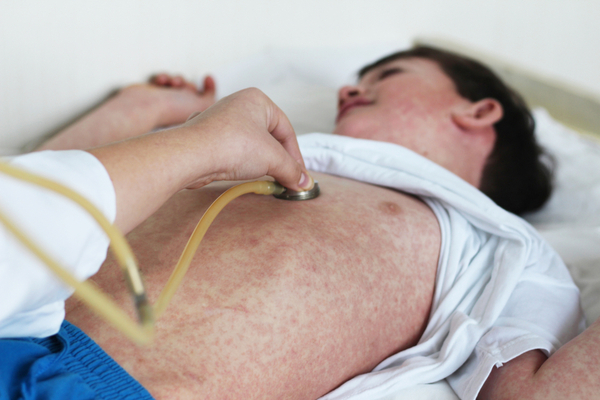
The most recognizable measles symptom is a very high fever accompanied by a red or brownish blotchy rash, although this is not the only symptom.
Before the rash appears, children with measles develop cold-like symptoms, including:
- Cough
- Runny nose
- Fever
- Red, watery eyes
These symptoms tend to get worse during the first 1 to 3 days of the illness.
To Protect Your Family and Stop the Spread, Vaccinate
According to the American Academy of Pediatrics (AAP), measles was once a common childhood disease, almost an expected part of growing up. While most children recovered from the measles without problems, many others did not. In some children, the infection caused pneumonia and in a few, encephalitis (infection of the brain) and even death.
Before the measles vaccine was available in the U.S., each year an average of 450 people died from measles; most of them were previously healthy children. Thanks to the measles vaccine, we can now protect children from the measles. In recent years, however, some parents have refused or delayed vaccinating their children out of fear or misinformation about the safety of the measles vaccine. This means there are more unvaccinated children, teens and adults in our communities.
Additional or early vaccination may be recommended in areas where measles continues to spread. For example, health departments may recommend a second dose for children age 1 to 4 years who received one dose and live in or plan to travel to the outbreak area. An early dose may be recommended for infants age 6 through 11 months living in or traveling to outbreak areas. Children who have not received any MMR vaccine may need two doses 28 days apart.
Both the CDC and AAP recommend children receive the measles, mumps and rubella (MMR) vaccine at age 12-15 months, and again at 4-6 years. Children can receive the second dose earlier if it is at least 28 days after the first dose.
Getting the measles vaccine is a better way to strengthen their immune system than getting a measles infection. Occasional effects after the measles vaccine include fever, tenderness at the injection site and rash.
—
Photo Credit: fotohay / Shutterstock.com
