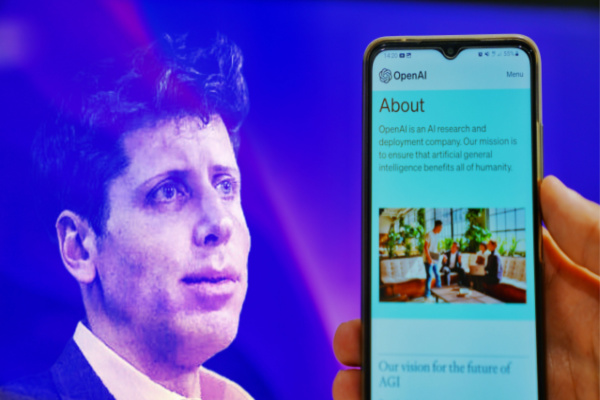
ChatGPT turns three this week, but its future seems more uncertain than many tech experts would’ve predicted just a few years ago. Large language models have become largely commodified, with similar interfaces and training data, making ChatGPT look less unique with each passing day.
As PCMag reports, the biggest threat comes from Google Gemini, which had a rocky start after ChatGPT caught it flat-footed, but is now starting to compete in earnest. However, even smaller players, such as Anthropic, as well as inexpensive open-source models, are rapidly establishing themselves.
OpenAI Sam Altman is keenly aware of the challenges ChatGPT is facing. He reportedly declared a “code red” this week and ordered staff to refocus on immediate improvements to its chatbot. Here’s a look at what it’s up against in its third year.
Google’s Revenge Is Near
With the November release of Gemini 3, Google’s AI was named the most capable AI chatbot, according to industry benchmarks, The Wall Street Journal (WSJ) reports. On X, Salesforce CEO Marc Benioff said “everything is sharper and faster” on Gemini 3. “I’m not going back [to ChatGPT].”
It’s sweet revenge for the tech giant after the internet roasted its first iteration of AI Overviews for recommending you put glue on pizza to make the cheese stick.
The WSJ acknowledges that ChatGPT still dominates the chatbot space. Its US market share was at 78% in November to Gemini’s 3.3%, according to StatCounter. However, I was surprised to see that the Gemini app has more than 650 million users per month, according to CEO Sundar Pichai, closing the gap with ChatGPT’s 800 million weekly users. In September, Gemini downloads overtook ChatGPT in global app stores thanks to Google’s Nano Banana image generator, TechCrunch reports.
That’s noticeable progress since Google issued its own “code red” in late 2022 over ChatGPT’s threat to its search business. Fast forward three years, and Pichai is now being praised as the “wartime CEO” the company needed, Bloomberg writes. Google is finally having its AI moment, though that could change on a dime like we’ve seen with AI over the past few years.
Claude and Open-Source Models Create More Competition
Beyond Google, ChatGPT faces competition on multiple other fronts. Anthropic’s Claude has carved out a niche for itself among programmers, overtaking ChatGPT’s efforts to do so with Codex. Its focus on workplace adoption distinguishes it from ChatGPT’s general-purpose vibe. The same goes for Microsoft Copilot, which is built into its ubiquitous operating system.
Even more concerning for ChatGPT is the trend of tech startups turning to cheap, open-source models, often made by Chinese AI companies, NBC News reports. Remember DeepSeek? It made waves in January, and took tech stocks for a tumble over claims that it offered similar performance to ChatGPT at a fraction of the price and compute power, although skeptics questioned some of these claims. DeepSeek is quietly continuing in the background, and just released a new version.
Startups may question why they should use ChatGPT on the backend if there are cheaper alternatives out there that make no difference to the end user. Individuals and hobbyists are saying the same thing, with some now making their own chatbots at home. They can offer more tailored data sets and targeted responses than black box systems like ChatGPT.
What’s ChatGPT’s Advantage at This Point?
As PCMag reports, to stay on top and stand out, OpenAI is going to have to home in on why someone should use it over the growing competition. Luckily, in the short term, its name recognition might be the biggest reason most people stick with it. But how long can that last? They might like the UI as well, or the tone of voice in the responses, but OpenAI constantly changes the latter. Others might feel stuck with ChatGPT since they have so much chat history, but Anthropic makes it surprisingly easy to port over the memory to Claude.
The number one use for ChatGPT might surprise you. No, it’s not brainstorming, summarizing, generating images, or making comparison charts. According to an OpenAI study, the biggest use is emotional support and help in making decisions. Over 70% of queries are for personal subjects, not work. That’s up 53% from just a year ago.
Altman has appeared caught off guard by the intimate role his chatbot plays in people’s lives, saying it sometimes makes him “uneasy.” The company grappled with a spate of suicides with potential links to ChatGPT conversations, and a growing number of AI-induced delusion claims. It’s spent the latter half of this year in damage control mode, introducing parental controls and working on improving how it reacts in “sensitive conversations.”
OpenAI doesn’t seem to be ready to lean into its competitive advantage as a personal confidant. It’s also doubling down on controversial conversations, teasing plans to introduce erotica that could end up being incredibly addictive—and lucrative.
No Time for an Existential Crisis: OpenAI Has Bills to Pay
OpenAI needs to figure out where it fits into this competitive landscape so it can start paying its mountain of bills and debts. The company will make about $13 billion in revenue this year, which is quite impressive. But it needs to make over $1 trillion to cover its planned costs in the next decade, TechCrunch reports. It’s unclear if that’s possible.
To keep investors happy, OpenAI is rapidly cooking up potential revenue streams, like its product discovery experience (not my favorite) and Instant Checkout tech. A year ago, OpenAI CFO Sarah Friar said an ad-based model was under consideration, though she later followed that up to say there were “no active plans to pursue advertising.” Meanwhile, Anthropic claims it’s on track to turn a profit much faster than OpenAI, the WSJ reports.
So while not all hope is lost for ChatGPT—far from it—the chatbot finds itself in a radically different position on year three than year one. It’s now facing real competition, with high funding, high stakes, and a higher risk of mediocrity than I would’ve expected. Let’s see how it shakes out a year from now.
—
Photo Credit: DIA TV / Shutterstock.com
