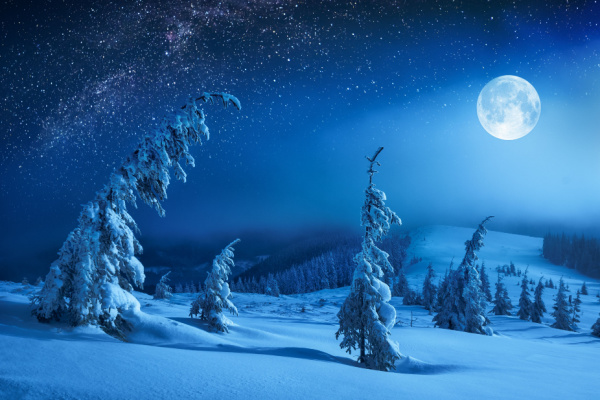
The days continue to get shorter and to further remind you the winter solstice approaches, December’s full moon is known as the longest night moon. That December full moon, also called the “Cold Moon,” is set to rise amid the longest nights of the year as a special, large, bright supermoon that will shine for days.
As USA Today reports, December’s supermoon will orbit closer to Earth than other typical full moons this year with the nearest point at 221,965 miles from Earth, according to the Almanac. It will be the third and last of consecutive supermoons to end 2025.
The cold supermoon is also known as the long night moon as it sets over the horizon during the longest nights of the year, approaching the December winter solstice. And if that weren’t enough to lure stargazers outside, this full cold supermoon will rise on the same night that the Geminid meteor shower starts.
The Geminids are usually the strongest meteor shower of the year and popularly known for producing bright and intensely colored meteors, shooting at medium-slow speeds from the constellation of Gemini.
Here’s everything to know about the next full moon, the Geminid meteor shower display and December’s winter solstice.
When will the Supermoon Rise?
The December cold supermoon is set to rise on Thursday, Dec. 4, with peak illumination at 6:14 p.m. ET. It will rise low on the horizon — making it appear larger and brighter — and like the November beaver moon, it will rise around the same time for several nights, including Wednesday and Friday.
You can check moonrise and moonset times for your ZIP code by visiting the Old Farmer’s Almanac online.
What is a Supermoon?
A supermoon happens when the moon’s orbit is closest to the Earth at the same time the moon is full. According to NASA, at approximately 226,000 miles from Earth, the full moon appears brighter and larger than a regular full moon, hence the term supermoon.
Because supermoons are closer to the Earth than normal, the illusion is that they appear larger and brighter. Supermoons come in three and fours, consecutively. This year it started with September and ends in January 2026; the next cycle of full moons will not come again until November of 2026.
Why is it called the Cold Moon?
December’s full moon is most commonly referred to as the cold moon or the long night moon, according to the Old Farmer’s Almanac. It usually occurs near the winter solstice, which is the longest night of the year, amid freezing temperatures that have settled in the northern hemisphere.
Other names for December’s full moon are derived from Native American, European and colonial sources, which include the drift clearing moon, and the little spirit moon.
What are the current moon phases?
- 🌕 Full moon: Dec. 4
- 🌗 Last quarter: Dec. 11
- 🌑 New moon: Dec. 19
- 🌓 First quarter: Dec. 27
When is the First Full Moon of 2026?
The first full moon of 2026 will be the January wolf supermoon, set to rise on Saturday, January 3, 2026.
—
Photo Credit: Vitalii Bashkatov / Shutterstock.com
