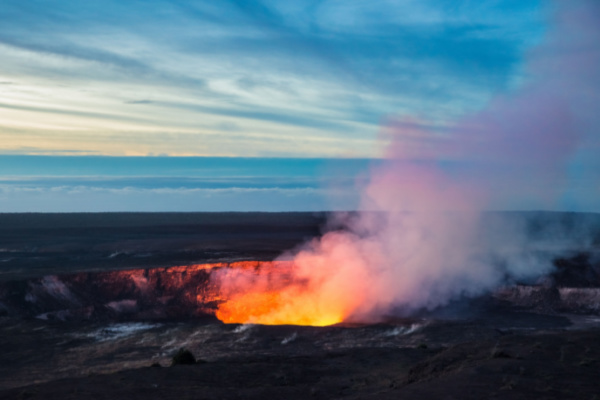
A magnitude 4.6 earthquake shook Hawaii on Tuesday night, striking on the southern side of the Kilauea volcano, hot on the heels (pun intended) of another major eruption from the active volcano.
Tuesday was a crazy day for the Big Island, and we’re not talking about Thanksgiving travel.
Kilauea Erupts… Again
First, Kilauea – one of the world’s most active volcanoes and one of six active volcanoes centered in the Hawaiian islands – erupted with a force that sent fountains of lava soaring 400 feet into the air. It’s the 37th time Kilauea has shot lava since last December, when the current eruption began.
As AP News reports, the latest lava display was preceded by sporadic spattering and overflows that began Friday. Each eruptive episode has lasted about a day or less. The volcano has paused for at least a few days in between.
In some cases, Kilauea’s lava towers have soared as high as skyscrapers. The volcano has generated such tall fountains in part because magma — which holds gases that are released as it rises — has been traveling to the surface through narrow, pipelike vents.
Kilauea is on Hawaii Island, the largest of the Hawaiian archipelago. It’s about 200 miles (322 kilometers) south of the state’s largest city, Honolulu, which is on Oahu. Luckily, the molten rock was confined within Kilauea’s summit caldera inside Hawaii Volcanoes National Park, the U.S. Geological Survey said. No homes were threatened.
Then the Island Shook
But as AccuWeather reports, before people had been able to digest the volcanic eruption, an earthquake occurred at 11:49 p.m. local time Tuesday night, and shaking was felt as far away as Honolulu, which is 226 miles northwest of the quake’s epicenter.
The tremor happened about 10 minutes after the 37th episode of the Kilauea volcano eruption ended, according to the USGS. Residents on the Big Island reported the strongest shaking, with some items being knocked off shelves. There were no immediate reports of major damage.
The most recent eruption lasted over nine hours on Tuesday, with fountains of lava reaching heights of up to 600 feet. “Kilauea has been erupting episodically within the summit caldera since December 23, 2024,” the USGS said.
“Within the past month and a half, fountaining episodes at the summit of Kilauea broke several records for this eruption,” the USGS added. “Recent episodes featured the highest lava fountains, the most volume of lava erupted, and the highest rate of lava effusion for this event, which has now lasted over 10 months.”
—
Photo Credit: Alexander Demyanenko / Shutterstock.com
