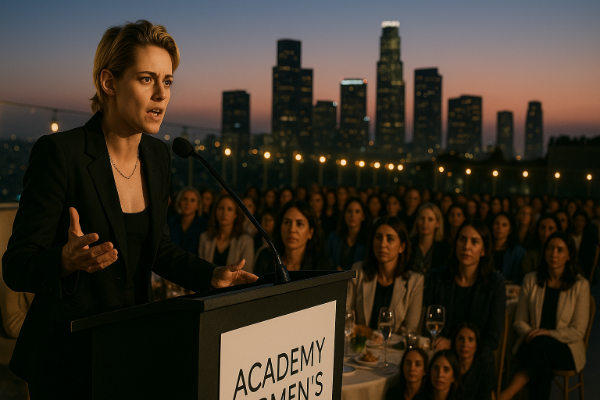
At the Academy Women’s Luncheon in Los Angeles, Kristen Stewart delivered a powerful keynote address that laid bare the stubborn gender inequities still dogging Hollywood. She did not mince words. “Our business is in a state of emergency,” she declared, drawing a sharp spotlight on the film‑industry structures that continue to under‑cut women’s voices.
Stewart pointed out that even after the #MeToo movement opened conversations around harassment and representation, the actual numbers tell a discouraging tale. According to recent reports, women directors made up only about 16 % of the top 250 domestic box‑office films in 2024. That figure is not improving — it’s slipping. That means stories by and for women remain dramatically under‑represented.
She described a deeper problem than simply unequal pay or access. Stewart referred to what she called “the violence of silencing” — the often‑invisible pressure on women to conform, to dilute their stories, to hide their anger. She lamented that when women do break through, too often it’s framed as symbolic rather than systemic. The message was clear: being invited to play is not the same as being given power.
Stewart drew on her own journey directing The Chronology of Water, an adaptation of Lidia Yuknavitch’s memoir, in which she grappled with themes of body, voice and reclamation. She noted how projects that deviate from safe, familiar tropes — especially those offering women’s interior lives in raw or unsettling form — still face an uphill battle. “When the content is too dark, too taboo, the frankness … frequently provokes disgust and rejection,” she said.
But Stewart’s address wasn’t only critique — it was also a rallying cry. Reject tokenism, she urged; don’t settle for the crumbs of progress. Instead, build your own table. Print your own currency. Support one another. Mentor, elevate, amplify. In the room — full of leading women in film — the energy shifted from lament to resolve.
Hollywood may be basking in past victories — female‑directed hits, high‑profile campaigns, inclusive messaging — but Stewart warned that the surface gloss hides a deeper erosion of opportunity. The moment demands more than publicity. It demands action, infrastructure, investment, and a structural rewrite.
For women in film, it’s time to stop waiting. The industry may offer the microphone, but it’s on women to take the stage, amplify each other, and never let the conversation become comfortable again.
