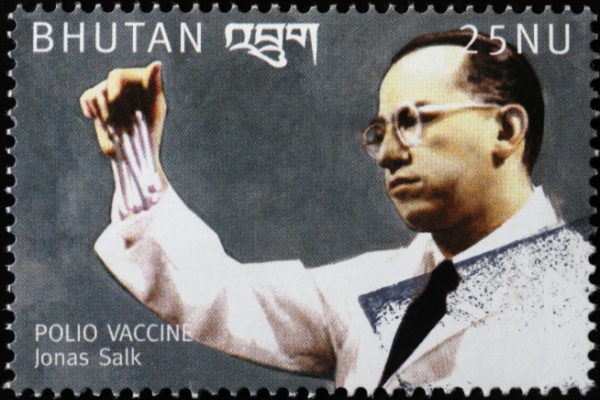
World Polio Day – celebrated annually on October 24 – was established by Rotary International to commemorate the birth of Jonas Salk, who led the first team to develop a vaccine against poliomyelitis. Use of this inactivated poliovirus vaccine and subsequent widespread use of the oral poliovirus vaccine developed by Albert Sabin led to establishment of the Global Polio Eradication Initiative (GPEI) in 1988. Since then, GPEI has reduced polio worldwide by 99 percent.
World Polio Day is an annual observance when members of Rotary International, along with public health advocates and individuals committed to a polio-free world, convene to commemorate their accomplishments in the global campaign against polio. This day also provides a platform for deliberation on the requisite measures to permanently eliminate polio from the face of the Earth.
About Jonas Salk and the First Polio Vaccine
Dr. Jonas Salk is credited with developing the first polio vaccine, which was approved for use in 1955.
Polio is an aggressive disease that attacks the central nervous system and can lead to paralytic poliomyelitis or paralysis. Children are highly susceptible to the disease, though rare it can also be contracted by adults. Franklin D. Roosevelt contracted the disease at age 39 and suffered paralysis but was able to partially recover, though he remained disabled for the rest of his life. Polio epidemics were common and highly feared, the Salk vaccine was developed at a moment when yearly polio cases in the U.S. ranged between 25,000 to 60,000. A particularly harsh outbreak in 1952 resulted in the death of over 3000 people.
Salk’s inoculation method injected a sample of polio virus that had been killed (inactivated) into the patient, thereby causing the generation of anti-bodies. After various controlled trials the vaccine was declared a success on April 12, 1955. Salk did not patent the vaccine, and therefore did not monetarily profit from it. For affordability and impact Salk partnered with pharmaceutical companies like Eli Lilly and Wyeth Laboratories to disseminate the vaccine widely.
Soon after the Salk vaccine was approved an oral polio vaccine was developed by Dr. Albert Sabin. Sabin’s vaccine used a weakened live form of the polio virus (live- attenuated) that could be dispensed orally as drops. Trials conducted in the Soviet Union in the late 1950s found the vaccine to be safe and effective, and more easily administered to children on a mass scale. Additional improvements on the vaccine would continue to develop, and international campaigns for mass vaccination would take place over the course of the 20th century.
Although he was the first to produce a polio vaccine, Salk did not win the Nobel Prize or become a member of the National Academy of Sciences. An object of public adulation because of his pioneering work, he spent his life trying to avoid the limelight but nevertheless endured the animosity of many of his colleagues who saw him as a “publicity hound.” In 1962 he founded the Salk Institute for Biological Studies in La Jolla, California, an enterprise initially funded with support from the March of Dimes. Salk’s own research continued, most significantly on multiple sclerosis, cancer, and AIDS. Salk spent the later years of his life committed to developing a killed-virus vaccine to prevent the development of AIDS in those infected with human immunodeficiency virus.
Sabin, too, continued his work and held a series of influential positions at such organizations as the Weizmann Institute of Science, the U.S. National Cancer Institute, and the National Institutes of Health.
By 1994 the World Health Organization (WHO) declared the Americas polio-free, and other continental regions followed in subsequent years. “Wild poliovirus” was declared eradicated from the USA 30 years ago, and according to the CDC, no cases have been detected as originating from American citizens. However, multiple cases determined to have been brought by travelers carrying the virus who are visiting the United States. Because of this, the WHO advises that consistent vaccination continue in the pursuit of complete eradication.
—
Photo Credit: spatuletail / Shutterstock.com
