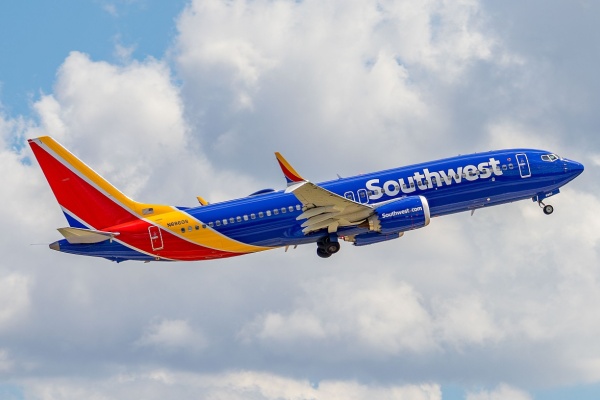
Southwest Airlines, citing safety concerns, will no longer allow passengers to charge their devices with a power bank stowed inside a carry-on bag. As MSN reports, as of May 28, travelers must place their activated portable charging equipment in a visible location, such as in a seat pocket or on a tray table.
In a statement, the airline said the initiative is an important measure in case a lithium-battery-powered device overheats or catches fire during a flight. The rule applies to charging devices stashed inside bags under a seat or in an overhead bin. Powered-off devices are still permitted inside cabin luggage, and people may use chargers that are in plain view.
“This policy by Southwest is trying to minimize and address that risk by having them visible and accessible,” said Hassan Shahidi, president and CEO of the Flight Safety Foundation, a nonprofit that advocates for aviation safety. “If it is not accessible, it is a problem.”
Most recently, on May 31, a Southwest Airlines plane going from Baltimore to Tampa was forced to divert to Myrtle Beach after a battery charger on board appeared to catch fire mid-flight. The plane landed safely and no injuries were reported.
From March 3, 2006, to April 27, 2025, the Federal Aviation Administration (FAA) says it has verified 620 lithium battery incidents involving smoke, fire or extreme heat on cargo and passenger aircraft. Battery packs, the electronic device with the highest frequency of occurrences, caused 240 of them. As of Memorial Day, the agency had recorded 22 events involving these devices this year. Last year’s total was 89.
Many Asian airlines have implemented stronger restrictions on the devices. Singapore Airlines and Thai Airways no longer allow passengers to use their power banks in-flight.
In a February announcement, South Korea’s Ministry of Land, Infrastructure and Transport said the storage of these items would be restricted to “their person” or the seat-back pocket, so flight attendants can respond immediately to any problems. Overhead storage and direct charging in any capacity — in-flight outlet, battery-to-battery — is not allowed. The ministry said it would provide “short-circuit prevention” plastic bags at check-in counters and onboard.
Since March 1, Korean-owned airlines have prohibited passengers from stowing these devices in overhead bins. Fliers must pack them in protective pouches or clear transparent plastic bags, or cover connectors with insulating tape. On the Taiwanese carrier Eva Air, travelers cannot use or charge their power banks during the flight.
The rule follows a serious incident aboard an Air Busan flight in South Korea in January, when a fire filled the cabin with smoke, leading to the evacuation of about 180 passengers and flight crew members. Investigators have not said whether they know the cause of the fire, but the country’s Transport Ministry said a degraded power bank could have been the culprit, Reuters reported in March.
Shahidi recommends passengers use the outlet by their seat to charge their devices. However, Gary Leff, founder of the View From the Wing blog, said that Southwest “has fewer outlets than most” and that they are “only USB.” To be safe, juice up your gadgets before your departure — but not to the top.
In a 2023 episode of the FAA’s podcast “The Air Up There,” Robert Ochs, manager of the fire safety branch at the FAA’s William J. Hughes Technical Center, recommends capping your phone charge at 30 percent. “It’s less likely to undergo thermal runaway, and the reaction would be less severe,” he says.
For devices you don’t plan to use on the flight, Ochs suggests unplugging them and powering them off.
—
Photo Credit: lorenzatx / Shutterstock.com
