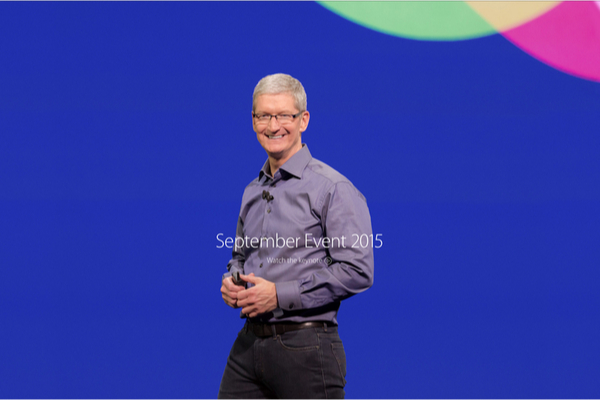
President Donald Trump has stated that he told Apple CEO Tim Cook he does not want the iPhone maker to expand manufacturing in India, asking Cook to increase production in the U.S. instead, following reports Apple was looking to shift production of U.S.-bound iPhones from China to India to avoid steep U.S. tariffs.
Apple and India’s Business Relationship Took Years to Develop
The business relationship that Apple has built with India isn’t anything new, and it took a long time to forge. As Fortune reports, for years, while the tech giant sold hundreds of millions of iPhones globally, its presence in the potentially huge market in that country, was minimal. The reason: India’s government required foreign firms to source 30% of their supplies from Indian companies. Wary of making such a big commitment, Apple instead relied on Indian distributors to sell its products, which meant lower profits and sometimes dodgy customer service.
Then, in 2016, after years of negotiations, the relationship between Apple and India suddenly thawed. India relaxed its rules for foreign companies, giving the green light for Apple to finally move in with an online store, retail outlets, and manufacturing plants. Over the years, Apple has sunk a huge amount of time, effort, and money to achieve what it has in India. The country has become a critical manufacturing hub for the company and, potentially, a major source of sales growth as millions of Indians climb the economic ladder.
There’s no disputing that Apple waited an eternity, in business terms, to create a major presence in India, the world’s most populous country. The company’s online store went live only in 2020. And In 2023, it cut the ribbon on its first brick and mortar outlet, in Mumbai, followed a couple of days later in New Delhi. The openings came a full two decades after Apple had built its first overseas store in Japan. The new outlets in India were such a big deal that Cook traveled there to mark the occasion. Apple plans to open more stores in India later this year.
President Trump Has a “Little Problem” with Apple in India
But now, President Donald Trump, in his effort to return manufacturing to the U.S. by hiking tariffs, is trying to break up the happy couple. Annoyed by Apple shifting some of its production from China to India, rather than to the U.S., he said on Thursday that he had scolded Apple CEO Tim Cook about it.
“I had a little problem with Tim Cook yesterday,” Trump recalled of their conversation. “I said to Tim, I said, ‘Tim, we treated you really good, we put up with all the plants that you built in China for years, now you got to build us,” Trump recounted. “We’re not interested in you building in India, India can take care of themselves.”
Apple is Caught Between a Rock and a Trump Place
Apple now finds itself caught in between two conflicting imperatives in India. By expanding production there, the company is racing to reduce its dependence on China while still keeping costs low. But in doing so, Apple is also making itself a target for Trump. Trying to balance the internal need for cheap labor and making Trump happy will require delicate diplomacy, if it’s possible at all.
As Fortune reports, the company’s share of the Indian smartphone sales is small, but growing. Last year, it controlled 8.2% of the market, up nearly two percentage points from 2023, according to IDC. That translates into Apple selling a record 12 million phones, making India the company’s fourth largest market after the U.S., China, and Japan. It doesn’t help that Apple’s phones are priced higher than most Indians earn in a month. The market is instead dominated by companies such as Vivo, Samsung, and Oppo that sell lower-cost devices.
In terms of manufacturing, India is also growing in importance for Apple. Trump’s trade war has made it even more so. Trump sent shockwaves across corporate America on April 2 when he announced his plan to impose a steep tax on products imported from abroad, including an astounding 145% levy on goods from China. For Apple, such a tariff risked causing huge financial pain because a big part of its production is in China.
Cook is Trying to Navigate Tariff Waters
But Cook, who earned his stripes mastering global supply chains as Apple’s former chief operating officer, was ready. On an earnings call with analysts earlier this month, Cook described how India has become a buffer against the Trump tariffs. Thanks to some quick maneuvering, most iPhones imported into the U.S. in the current quarter will come from India, where tariffs would be only 26%.
“Cook has navigated this unprecedented supply chain situation in a ‘hall of fame moment’ that will be part of his legacy,” Wedbush Securities analyst Dan Ives roared approvingly in a research note on Friday. If needed by the Fall, Ives said, Apple could ramp up iPhone production in India by up to 65%.
If Apple was able to be nimble in the face of Trump’s “liberation day,” it’s because the company has been gradually shifting some of its product assembly to India, along with Vietnam, for several years. Executives had realized the company was overly dependent on China and needed to hedge its bets. In 2023, an Indian official told reporters that Apple’s goal was to eventually produce 25% of its iPhones in India.
Like in most countries, Apple uses third-parties in India, such as Foxconn and Tata Group, to produce its devices. This week, for example, Indian officials said a $435 million semiconductor plant proposed by a joint venture between Taiwan-based Foxconn and India’s HCL had been approved. Manufacturing in India, however, has its downsides. Supplies and infrastructure are often more expensive than in China. Apple did not respond to a request for comment.
Trump is Indirectly Targeting India’s Government
In attacking Apple over its expanding India manufacturing, Trump is also indirectly targeting Indian Prime Minister Narendra Modi. Modi has made increasing tech manufacturing a major pillar of his administration and Apple is one of his biggest wins. “Symbolically, it’s very important for India, especially vis à vis China,” Saikat Chaudhuri, a professor of business and engineering at University of California at Berkeley.
Modi’s previous efforts to curry favor with Trump, whose politics largely mirror his own, don’t seem to have paid off, at least for now. For example, in 2020, Modi hosted Trump at a rally in his home state of Gujarat before 100,000 people. Additionally, Trump said this week that Modi’s government had offered to lower tariffs on U.S. imports to zero, in what would be a major concession. India responded that no deal has been finalized.
In his remarks about the issue, Trump said he has no problem with Apple producing iPhones in India for the Indian market. What he doesn’t want, he said, is the company making devices there for U.S. consumers. Instead, Trump called on Cook to move that production to the U.S. He cited a recent promise by Apple to spend $500 billion in the U.S. over the next four years, including on a plant in Houston to produce chips for servers.
Chaudhuri called Trump’s latest comments about Apple and India “a lot of rhetoric” that will ultimately be resolved without Apple having to move some iPhone production from India to the U.S. Doing so would be impractical, Chaudhuri said, because manufacturing the devices in the U.S. would make them prohibitively expensive. It would also take years to get a plant up and running. While Trump wants to create jobs, he also wants to avoid interrupting the flow of commerce, Chaudhuri said, adding “I think it’s in everyone’s interest to strike a deal.”
—
Photo Credit: PriceM / Shutterstock.com
