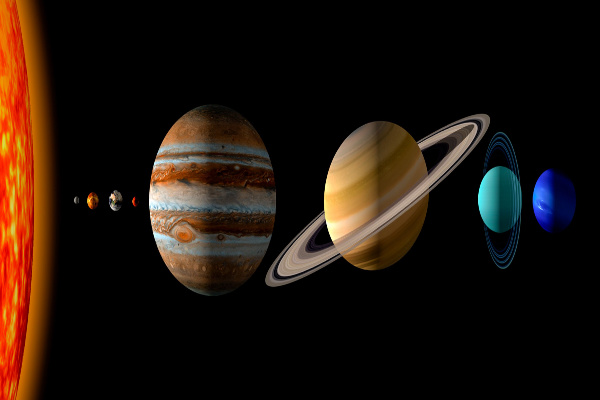
You may see a lot of media hype about a “great planet alignment” on January 25. Perhaps you won’t believe it to be the most magical lineup ever, but it WILL be an amazing planetary display you won’t want to miss. It’s truly the best overall planet view in years.
The 8 Planets
First, a quick review. According to The Old Farmer’s Almanac, of the eight planets in our Solar System, there are five “bright planets” you can see with the naked eye (no gear) and only four planets that you can easily see without any problem. The fifth one, Mercury, is always near the Sun and never visible against a lovely dark sky, nor is it ever high up.
- Half of the four brilliant planets—Venus and Jupiter—are always dazzling.
- Saturn is always bright but not eye-catching.
- Mars varies its luminosity so much that it’s usually no more conspicuous than dozens of actual stars—nothing that would catch your eye.
Then there’s the realtor’s old, repetitious melody about “location, location, location.” If a planet is bright but doesn’t rise until 5 AM, how many will bother to set an alarm to take a look? Or if the planet is so low that trees and distant hills block it, it doesn’t make our must-see list, no matter how bright it gets.
It’s not unusual to see planets in a long line in the sky and note Uranus and Neptune are not even visible with the naked eye or binoculars. However, what is special is to see four bright planets at the same time! It will be an amazing planet display you don’t want to miss. Look to the southwest for super-bright Venus and Saturn. Then, look southwest for Jupiter high in the sky. Finally, look east for orange-red Mars.
An Amazing Planet Display in January
That’s why the present planet spectacle is so unusual. Of course, much of the talk on the web and even in print is getting it wrong. Many are calling it a “lineup of planets.” In actuality, two of them are on one side of the sky (lowish in the west) while the others hover in exactly the opposite direction in the east. So it’s actually not really a line at all, but more the path that the Sun traces which is known as the “ecliptic.” The planets visible in this alignment are Venus, Mars, Jupiter, Saturn, Uranus and Neptune.
How can you tell the difference between Planets and Stars?
The scientific explanation for knowing how to differentiate in the sky between a planet and a star is simple: the Earth and the other planets of our Solar System are formed from the same flat disk of gas and dust that surrounded the Sun when it all began, so all the planets occupy the same orbital plane and all follow the line of the ecliptic.
When and how can I see the planets aligned?
Some say that anywhere from January 21 through 25 is the ideal time to view the phenomenon because the moon wanes and loses its brightness, but throughout January 2025 and very early February, this phenomenon can be seen at around 7:00 p.m. CT every day.
Mars will be in the east, Jupiter in the southeast, Venus and Saturn side by side in the southwest, while Jupiter is visible above the constellation Orion, Venus appears a remarkably bright star in the twilight sky, Mars looks bright and high, while Uranus and Neptune are also visible, although in the darker sky, so a telescope is required for observation.
—
Photo Credit: MattLphotography / Shutterstock.com
