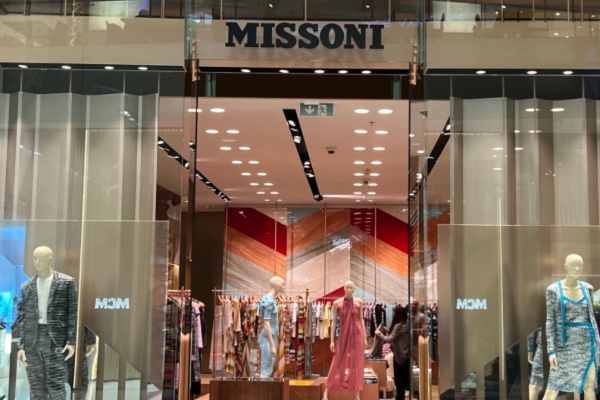
Rosita Missoni, co-founder of the eponymous Italian knitwear label Missoni, has died aged 93. Alongside her husband Ottavio ‘Tai’ Missoni, who predeceased her in 2013, she made the family name synonymous with Italian fashion’s most joyous and instantly identifiable visual code: the Missoni zigzag knit.
As BBC News reports, the news was confirmed by the president of Italy’s Lombardy region, Attilio Fontana, who praised the brand’s iconic “multicoloured textures”. He described her death as “a great loss for Italy, Lombardy and for the province of Varese where she was born and lived”.
Rosita, whose parents both worked in the family’s shawl and embroidery factory, was born in 1931 in the town of Golasecca, Lombardy. While on a study trip to learn English in London, she met Tai while he was competing in the 400m hurdles at the 1948 Olympic Games. At the time, Tai was producing his own knit tracksuits, including bottoms with a zip so they could be put on over trainers, and Missoni had already developed an ahead-of-its time business idea manufacturing and selling tracksuits, which were later adopted by the Italian national team for which he competed.
“When I got married, four sewing machines arrived with my husband,” Rosita told the AFP news agency in a 2016 interview. The pair, who married in 1953, initially set up a machine-knitwear workshop in Gallarate, northwest of Milan. Their company was at first named Maglifio Jolly, and its nerve center was the four knitting machines they set up in the basement studio of their house. However by 1958, when their third child Angela was born, they had generated enough interest from retail clients including Biki and Rinascente to place their own name—Missoni—on the label of the garments they created.
If “color is the story of our life,” as Rosita once said, then hers was a life as rich and vivid as any of the patterns she and Ottavio invented. As Vogue reports, these inventions were made possible by their breakthrough 1962 experiment to use Raschel weaving machines to create highly distinct ‘fiammata’ (flames) patterned knitwear. A key element in that experiment’s success was Rosita’s heritage and expertise in textiles.
Their zigzag-shaped eureka moment four years later was finely timed. The vaguely psychedelic and wonderfully colorful patterns that Missoni was now proprietarily able to produce would fall in sync with the wider spirit of the 1960s, and also coincide with the rise of Italian ready-to-wear as an alternative to the hoity-toity French fashion incumbents. Missoni hosted some of its earliest fashion shows after the editor Anna Piaggi discovered the label in the mid 1960s. Its very first, fall 1966, was shown in Milan, before later presentations in Paris, the Pitti Palace in Florence, and London.
A controversy erupted – which turned out to be great luck for developing brand awareness – over the see-through quality of clothing. Models were asked to remove their white bras because they could be seen under blouses, and Rosita and Tai didn’t realize that the sweaters would appear see-through under the bright catwalk lights. The scandal propelled the brand into global fame.
During the 1970s Missoni’s signature motifs would come to communicate progressive Italian fashion across the US. This was in part thanks to the support of Vogue editor Diana Vreeland, who in November 1970 invited the Missonis to show their collections to an audience of buyers and Vogue staffers at the Palace Hotel. The Missoni look was christened the ‘put-together’: Saks Fifth Avenue and Neiman Marcus began stocking it shortly afterwards, and Bloomingdale’s gave the newcomer its own store-in-store. When Milan Fashion Week formally began a few years later, Missoni was amongst the founding brands. During the 1980s it established a homewares business and expanded into fragrance and beauty.
According to Vogue, after more than 40 years leading the house—and a self-confessed slump during the 1990s—Rosita and Ottavio began handing down control of the family business to sons Vittorio and Luca and daughter Angela (who presented her first collection as creative designer in 1997). “My mother was equal parts creative visionary and fearless leader,” Angela told Vogue. “She had the determination to make things happen and, together with my father, changed the course of fashion. She brought this same energy to every part of our family life—she showed us how to live life in color and created a Missoni lifestyle long before the term lifestyle brand was coined.”
While their children worked to effectively revitalize the visual language their parents had created, Rosita, unwilling “to live like a grandmother,” focused specifically on the Missoni Home part of the business. This enabled her to pursue multiple passions; for decoration, research trips, homemaking, and even scuba diving and mushroom-hunting.
After enduring a cruel 2013, the year in which Vittorio died in a plane crash shortly before Ottavio passed away, Rosita continued to lead her now sprawling family in great style. This last September, she was an enthusiastic guest at the presentation of her granddaughter Margherita’s label, Maccapani. As she once told Vogue of her appetite for fashion and design: “It’s a pleasure and a passion, and it has come from living this wonderful life.”
—
Photo Credit: Ritu Manoj Jethani / Shutterstock.com
