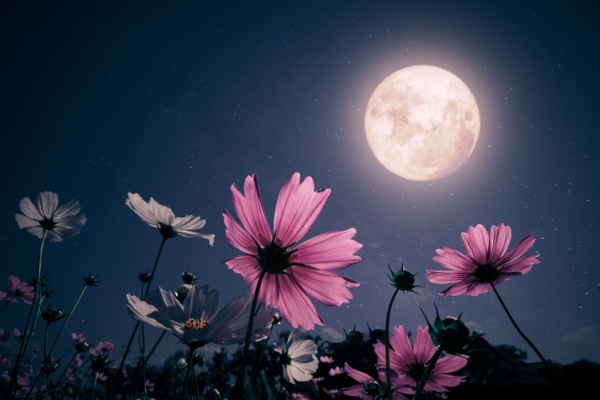
As we inch closer to summer, the last full moon of spring will rise one week after the Eta Aquarids, a lunar event linked to the many changes associated with Spring. This year, that happens on the night of May 12. The full moon will reach peak illumination at 12:56 p.m. EDT, according to Space.com. It will be below the horizon at that time for most of the United States, so venture outdoors on Monday night to get the best view of the bright, full Flower Moon!
The Old Farmer’s Almanac, which first began publishing the names for the full moons in the 1930s, states that some Native American tribes – Algonquin and Ojibwe peoples – consider to the full Moon in May to be the “Flower Moon” because flowers spring forth across North America in abundance around this time. Other tribes reportedly named the moon based on the arrival of spring.
For example, the Old Farmer’s Almanac states that some northern Native American tribes referred to the May full moon as the “Budding Moon” or “Leaf Budding Moon” to celebrate the spring’s new blooms. Some even called it the “Planting Moon” because it marked the time when seeds should be planted for the farming season ahead. Other names for this moon are “Frog Moon” (frogs are very active in Spring after being dormant through most of the Winter season) and “Egg Laying Moon.”
According to NASA, an old English name for this Moon is the “Milk Moon” and in 703 AD the English monk St. Bede the Venerable wrote that what we now call May was the “Three-Milkings Month,” apparently due to this month being when cows could be milked three times a day.
Many ancient cultures and religions celebrate celestial cycles, including finding ways to honor and harness the power of the full moon. To make best use of this intense energy, many astrologers believe that a full moon is a great time to manifest your dreams.
—
Photo Credit: jakkapan / Shutterstock.com
