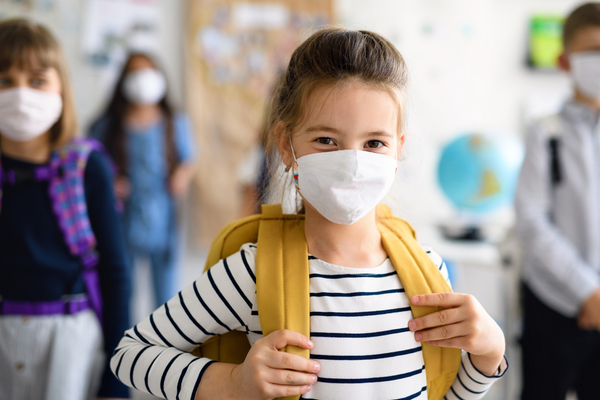
As the so-called “tripledemic” of flu, RSV and COVID-19 continues across the United States, health officials are encouraging people to wear face masks again, especially children.
As ABC News reports, health officials in multiple states, including New York, California and Arizona, are strongly recommending people wear masks because of the ongoing threat of flu, COVID-19 and RSV happening all at once.
According to the Centers for Disease Control and Prevention (CDC), the U.S. has already surpassed 10 million cases of flu-like illnesses, leading health experts to warn this could be the worst flu season the country has seen in a decade. Currently, over 40 states are reporting high or very high rates of flu-like illnesses.
In addition, COVID-19 cases and deaths rose by 50% over the past week, despite the rate previously remaining flat for a long period of time, according to the CDC. And then there’s the new uninvited guest at the party, RSV. The number of cases of RSV, or respiratory syncytial virus, hit a two-year high in November, leading the CDC to issue an official health advisory in response to the rise in respiratory infections in children.
The ongoing higher rates of flu, RSV and COVID-19 come at a time when children tend to be indoors more often due to colder weather, and when families tend to be busy with school activities and holiday gatherings. As a result of the ongoing surge, health officials highly recommend that both children and adults should wear a face mask when possible in crowded, indoor spaces to avoid both spreading and catching viruses, according to Dr. Elizabeth B. Murray, who is also a spokesperson for the American Academy of Pediatrics.
The CDC continues to recommend mask-wearing for children and adults on public transportation, including trains, planes and buses.
In the absence of mask mandates, Murray said that families need to make the best decisions for themselves, knowing that each family and each individual child is unique. “It would be so awesome and so easy if we could just kind of say, ‘You always do this,’ or, ‘You never do that,’ and it really is not at that point,” she said. “But as we head into the holidays and we want to make sure we’re healthy to see our families, now is the time to really take those precautions.”
Murray said it is especially important for parents and caregivers to wear masks in order to set an example for their children.
According to Murray, children’s immune systems were not permanently damaged by wearing masks during the pandemic. “The mask just helps to decrease transmission of a lot of the common illnesses,” said Murray. “Now that people are not wearing masks anymore, now that schools are back in an in-person setting and now that it’s fall and winter when we see some of these germs start to come around, it makes sense that everything is back.” She continued, “We had years when kids just were not seeing as much illness and now everybody’s getting sick because all of the germs are back at once.”
Children can start wearing face masks starting at age 2, according to both the CDC and the American Academy of Pediatrics.
Murray recommends that children wear “high-quality” masks that they feel comfortable in and will wear. “There are different styles that can work equally well, so really making sure that you have a mask that your child likes and fits comfortably on their face is important,” she said. “Sometimes it’s hard to find smaller masks but there are good resources out there.”
In order for a mask to be effective, it needs to fit over the nose and cover under the chin and should lay flat on the skin. Experts say it is fine for kids to use clips or bands to relieve pressure on their ears when wearing a mask. One technique to check the quality of your child’s mask is to hold the mask up to the sun. If you can see light through the mask as you hold it stretched, it’s not thick enough.
What else can you do to protect your children this Winter? First and foremost, Murray said it is critical that children and adults are up to date with their vaccinations. Children ages 6 months and older are eligible to get a flu vaccine as well as a COVID-19 vaccine, with “rare exceptions,” according to the CDC. Both vaccinations are free and are widely available at doctors’ offices and local pharmacies.
Murray said she also encourages her patients and others to stay home if they are sick and to keep their children home from school and activities if they are showing symptoms of illness. “I think people have a lot of pressure to get back to work and all of those things, but still we really need to make sure that regardless of what you’re sick with, when people are ill, they need to stay home,” she said.
—
Photo Credit: Halfpoint / Shutterstock.com
