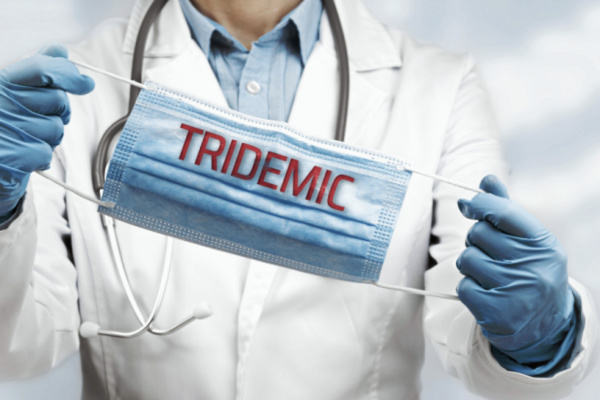
Public health officials’ warnings of a “tripledemic” are intensifying as Americans head into the holiday season. Across the country, hospitals, especially those specializing in children, are being overrun, namely due to cases of infectious respiratory illnesses, like respiratory syncytial virus (RSV), influenza and COVID-19, which together make a nasty “tripledemic.”
“This is a unique situation where we have COVID, RSV and the flu circulating and making make people sick,” Dr. Michael Phillips, infectious disease specialist at NYU Langone Health, said in an interview with NBC’s TODAY show.
Just a few weeks ago, on Nov. 8, NBC News reported that 76% of pediatric hospital beds in the U.S. were full, with Rhode Island at 100% capacity and Washington, D.C., and Arizona hitting 98% and 96% respectively.
Around the same time, the Centers for Disease Control and Prevention added a new level, “very high,” to its state-by-state map of flu activity, NBC affiliate WILX in Lansing, Michigan reported. Several states in the South and D.C. fall into this category and much of the country has high levels. Peak flu season usually extends from December to February in the U.S. but rates are already ticking up.
Even though flu and RSV may be a bit early, it’s typical in winter to see a surge of these viruses, Dr. Michael Angarone, associate professor of infectious diseases at Northwestern Medicine in Chicago, said in an interview with TODAY.com. But this year is likely to be different: “What we are worried about is having the typical cold and flu seasons combined with SARS-CoV-2,” he says.
The real fear around a tripledemic is the possibility that the three viruses will peak at the same time and inundate hospitals, filling every bed and stretching staff thin, because the TODAY show reports that another factor straining the U.S. health care system? The ongoing health worker shortage, exacerbated by the COVID-19 pandemic. In some hospitals, there are beds available, but there isn’t an adequate number of nurses and doctors to treat any more patients.
RSV, COVID-19 and flu are more likely to have a severe impact on parts of the country that are colder, Dr. David Buchholz, a pediatrician and founding medical director of primary care at Columbia University in New York City, tells TODAY.com. As of November 12, 14 states, New York City and Washington, D.C., have flu activity that the CDC has categorized as “very high.” These are:
- Alabama
- Arkansas
- Colorado
- Georgia
- Kentucky
- Maryland
- Mississippi
- New Jersey
- New Mexico
- North Carolina
- South Carolina
- Tennessee
- Texas
- Virginia
Brewer also says the parts of the U.S. with the lowest vaccination rates against COVID-19 and flu “will most likely get into trouble with these viruses,” he said. (There’s no vaccine against RSV.) For last year’s flu season, these states had the lowest flu vaccination rates, according to data from the Kaiser Family Foundation:
- Mississippi
- Wyoming
- Nevada
- Idaho
- Florida
The best way for people to protect themselves amid the possibility of a tripledemic is to get the latest COVID-19 booster and a flu shot, Angarone says. So far, it looks like the flu vaccine this year is a good match to the strains of influenza virus currently circulating, Brewer adds. There’s no vaccine for RSV, but one could be on the horizon.
Even though most people will not experience severe symptoms with RSV and the flu, “we have to be aware of others when we are sick,” Angarone says. “Even though it’s not COVID-19, you probably should not go to work and get your colleagues sick. You should make sure you are washing your hands.”
Some experts have also continued to recommend masking and opening windows at indoor, crowded events. And in his last White House briefing, Dr. Anthony Fauci, the president’s chief medical adviser, encouraged taking a rapid COVID test before family gatherings.
—
Photo Credit: taniascamera / Shutterstock.com
