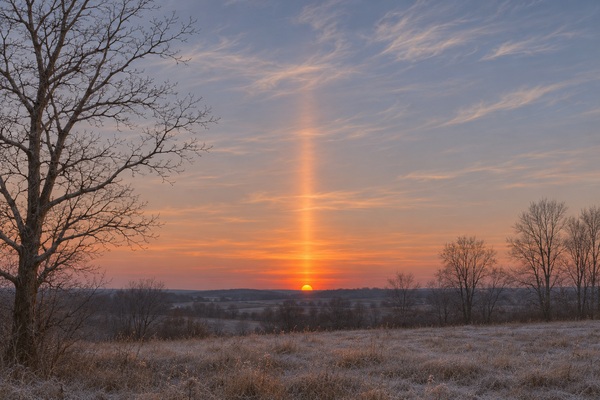
Sometimes a sunset seems to leave a narrow column of light standing above the horizon. It can look surprisingly straight against a sky full of soft edges. That upright glow may be a sun pillar, an effect made by light and ice rather than a beam shining up from the ground.
The National Weather Service’s guide to atmospheric optics describes pillars as sunlight reflected from ice crystals falling slowly through the air. They are often seen around sunrise or sunset, when the sun is low. Thin, high cirrus clouds can provide the icy setting.
The crystals matter because their orientation determines which light reaches an observer. NASA’s explanation of a photographed pillar emphasizes that suitably aligned crystals reflect the sunlight to create the effect. You are seeing a pattern of reflected light, not a solid tower hanging in the atmosphere.
A useful first observation is the shape. A pillar extends vertically above the sun. A sundog is a bright patch to the side, and a halo forms a ring. These effects can share an icy ingredient while arranging the light differently. Calling every bright sunset feature a rainbow loses that distinction.
If you notice one, take in the surrounding sky from a safe place rather than concentrating on the sun itself. Never look at the sun through binoculars, a telescope or an unfiltered camera viewfinder. A low sun is not an invitation to magnify it.
You can note whether the glow fades as the sun moves and whether thin cloud is visible nearby. Those observations help turn an unusual view into a question you can compare with an official example later.
There is no promise of a pillar in your sky this evening, and a sighting is not a complete weather forecast. The interesting part is smaller and more immediate: a little ice high above can make an ordinary sunset appear to have one very orderly edge.
