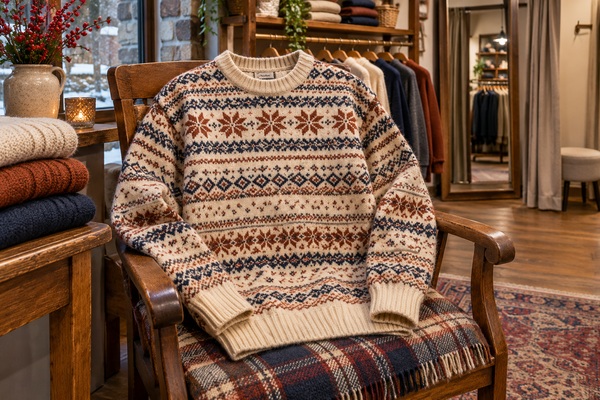
A sweater covered in little geometric bands can bring plenty of color to a winter outfit. Its product description may also introduce a familiar name: Fair Isle. Before treating that as another word for any festive knit, it helps to separate a technique from the tradition behind it.
The Shetland’s Organisation for Knitters explanation distinguishes Fair Isle from the broader family of stranded colorwork. In that technique, yarn that is not being used travels behind the active stitches. Fair Isle belongs within that family; it does not name the entire family.
Heritage Crafts describes traditional Fair Isle work in pure Shetland wool, with geometric motifs and no more than two colors in a single row. That last detail is easy to misread. A whole garment can have a rich palette while an individual row uses only two of its colors.
For a shopper, this makes the close-up photograph more interesting. Follow one narrow band instead of taking in the sweater as one busy surface. Notice how a dark motif sits against a lighter background, then how the next band changes the balance. Those decisions create rhythm without requiring one large picture on the chest.
It also gives you better questions for the seller. Who designed the garment? Where was it made? Is the description identifying a knitting tradition, a place of manufacture, or simply an inspiration? A pattern name by itself cannot answer all three.
You can enjoy a colorful sweater without becoming a textile historian. Try it with a quiet pair of trousers and see whether you prefer the pattern to lead the outfit. When describing it, keep the maker’s information alongside the motif: the story of the knitting deserves as much care as the color choice.
